Get Full Government Meeting Transcripts, Videos, & Alerts Forever!
Get email alerts on the Homeless Shelters Standards Of Care topic
No spam. Unsubscribe anytime.
Shelter monitoring committee urges uniform standards after site visits find hygiene and safety gaps
Summary
The Shelter Monitoring Committee reported 33 site visits (Jan–Mar 2007), documented a 25% loss of sleeping units for single women, complaints about staff conduct and lack of hygiene supplies, and urged a gender analysis and a citywide standard of care; HSA and DPH representatives engaged on next steps.
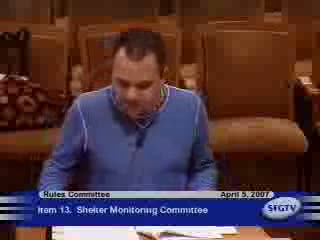
The Shelter Monitoring Committee presented its quarterly report covering Jan. 1–March 30, 2007, to the Rules Committee, documenting inspections, resident complaints and recommended next steps to establish a uniform standard of care across city-funded shelters.
Vice Chair Damien Ochoa said the committee conducted 33 site visits covering more than 80 percent of shelter sites and logged a 25 percent reduction in sleeping units available to single women. The committee detailed complaints about staff behavior, inconsistent opening hours, and poor access to hygiene supplies such as toilet paper, soap and paper towels. "Over 90 percent of the complaints included or were exclusive complaints about staff," Ochoa said, and the committee cited specific concerns observed during unannounced inspections at sites including 150 Otis and 39 Fell (the McMillan drop-in center), where staff practices, broken furnishings and visible knife marks raised safety and maintenance concerns.
The committee urged the Human Services Agency (HSA) and Department of Public Health (DPH) to conduct a gender analysis as recommended by the city's CEDAW ordinance and to work with stakeholders to develop a uniform standard of care for shelters. Joyce Crum of HSA disputed a blanket claim that the agency did not respond to committee requests, saying HSA has replied to written requests and participates in parallel standard-of-care work groups. DPH staff described efforts to improve clinical support for shelters, including 24/7 medical consultation and coordination on communicable-disease prevention and crisis response.
Supervisors asked for follow-up; the chair proposed an off-line meeting with HSA and DPH to seek concrete fixes, including how to ensure hygiene supplies are accessible without creating other management problems. The committee will continue work on the standard-of-care group and provide further reports to the board.