Get Full Government Meeting Transcripts, Videos, & Alerts Forever!
Get email alerts on the Paid Sick Leave topic
No spam. Unsubscribe anytime.
Rules Committee presses OLSE on implementation of San Francisco paid sick leave law
Summary
Supervisors and dozens of public commenters questioned Office of Labor Standards Enforcement staff about how Proposition F (Chapter 12W) will be implemented before its Feb. 5 effective date, raising issues about accrual, temporary and commissioned workers, collective bargaining, and outreach to small businesses and employees.
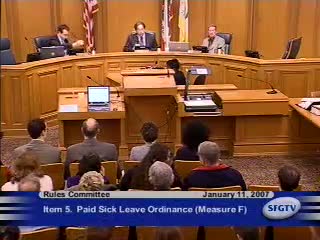
The San Francisco Rules Committee held a lengthy January hearing to review how the Office of Labor Standards Enforcement will implement the paid sick leave ordinance approved by voters as Proposition F and codified as Chapter 12W of the San Francisco Administrative Code.
Donna Levitt, representing OLSE, told supervisors that the law takes effect Feb. 5 and that accrual begins on that date for employees working in San Francisco. "For every 30 hours worked, an employee accrues one hour of paid sick leave," Levitt said, noting the ordinance sets caps on accrual at any given time — 40 hours for employers with fewer than 10 employees and 72 hours for employers with 10 or more. She said accrued leave carries over year to year and that there is no annual limit on how much leave a worker may use in a year.
The hearing focused on implementation details employers say they need. Business representatives — including Dan Ebert of BAE Systems and Jim Lazarus of the San Francisco Chamber of Commerce — pressed OLSE on interactions with existing collective bargaining agreements, how the 90‑day accrual trigger will work, who is the covered employer for temporary staffing situations, and how the rule will apply to commission-paid or exempt employees. "The trigger of 90 days was too quick," Lazarus said, urging the Board to consider additional time for outreach or an implementation delay.
Levitt said OLSE will publish a draft set of roughly 45 frequently asked questions, mail a six‑language informational poster to registered businesses, and run outreach with the Mayor's Office of Economic and Workforce Development and the Small Business Commission. She said the city’s enforcement model will be complaint driven: workers who believe they were denied rights can file a complaint with OLSE, which will investigate. For verification, Levitt said the ordinance allows "reasonable" verification policies but rejected requiring a doctor's note for every absence as unreasonable.
Worker advocates who had organized the ballot effort pressed for strong worker outreach and enforcement. Speakers from Young Workers United, Parent Voices and Coleman Advocates urged workshops and clear, worker-facing complaint channels so employees can use and enforce the benefit.
Payroll and staffing representatives — including ADP and local staffing firms — asked how to track hours for employees who split work across jurisdictions or who are paid by commission. Levitt said employers will need to track hours worked in San Francisco to comply and that some technical issues may require future rulemaking.
Supervisors and OLSE noted next steps: OLSE will post FAQs, continue targeted outreach and workshops, and the committee agreed to continue the hearing "to the call of the chair" for follow-up. Levitt gave a hotline (554-6271) and directed users to OLSE materials on the city's website for additional information.
The committee emphasized the need for continued public forums and a robust education campaign before the effective date; supervisors also discussed potential budget needs to support outreach and enforcement. The committee closed the item and moved on to the closed-session portion of the agenda.