Get Full Government Meeting Transcripts, Videos, & Alerts Forever!
Get email alerts on the Reparations Disclosure topic
No spam. Unsubscribe anytime.
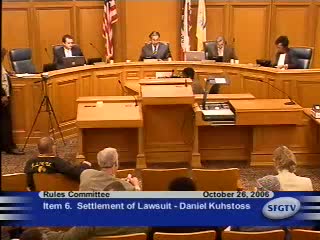
Rules Committee Advances Slavery Era Disclosure Ordinance After Hours of Testimony; Sends Measure to Full Board
Summary
Supervisor Sophie Maxwell’s proposed ordinance would require certain city contractors to disclose ties to the slave trade and create a voluntary contribution account to fund economic and educational initiatives; the committee voted to forward the ordinance to the full Board with a committee recommendation after extensive presentations and public comment.
The Rules Committee advanced a proposed Slavery Era Disclosure Ordinance and agreed to forward it as a committee report to the full Board of Supervisors with a recommendation. The ordinance, introduced by Supervisor Sophie Maxwell, would amend the Administrative Code to require contractors providing insurance, insurance services, financial services or textiles to disclose participation in the slave trade and create an account accepting voluntary contributions to fund economic development and educational initiatives addressing the legacy of slavery.
Supervisor Maxwell framed the proposal as part of a broader movement to document how slavery contributed to wealth accumulation and to support public education and reparative initiatives. ‘‘The Slavery Era Accountability Ordinance is important because it brings truth and transparency to the processes by which wealth was accumulated in America,’’ Maxwell said when introducing the measure.
Presenters included Al Williams (San Francisco African American Historical and Cultural Society), John Damou (National Coalition of Blacks for Reparations in America) and Professor Rhonda McGee (University of San Francisco), who outlined legal context, precedent and likely effects. Professor McGee said the measure does not mandate reparations payments but requires information disclosure; she cited examples from other cities where disclosure prompted corporate responses. McGee referenced Chicago disclosures that led banks to provide historical details and corporate commitments and cited a corporate scholarship commitment as an example.
The committee heard sustained public testimony from community leaders, academics, students and longtime residents. Speakers connected the ordinance to corrective justice, education and efforts to address displacement and the long-term economic impact on African American residents. Tiffany Willoughby Herold, a San Francisco State University political-philosophy instructor, urged supervisors to ‘‘unapologetically confront’’ stereotypes and structural barriers and described the ordinance as a ‘‘small step’’ with moral and economic implications.
Committee members expressed support, discussed outreach to the Human Rights Commission and agreed to hold a press conference to publicize the ordinance. The committee recorded the matter as a committee report scheduled to appear on the full Board agenda (noticed for the next Tuesday/Oct. 30 in the transcript) and moved it forward with recommendation.
Next steps: placement on the full Board agenda as a committee report; additional hearings or letters to the Human Rights Commission were discussed by members as follow-up actions.