Get Full Government Meeting Transcripts, Videos, & Alerts Forever!
Get email alerts on the Police Contracts topic
No spam. Unsubscribe anytime.
Supervisors send police MOU to full Board without recommendation after hours of public comment
Summary
After hours of public comment demanding transparency and policy concessions, the Government Audit and Oversight Committee transmitted the Police Officers Association MOU to the Board of Supervisors with no recommendation on Nov. 5, 2020. DHR said legal constraints limit what can be put into MOUs; critics urged the board to reject the deal.
The Government Audit and Oversight Committee on Nov. 5, 2020 transmitted the Police Officers Association (POA) memorandum of understanding to the full Board of Supervisors with no committee recommendation after a long public comment period in which callers demanded renegotiation and transparency.
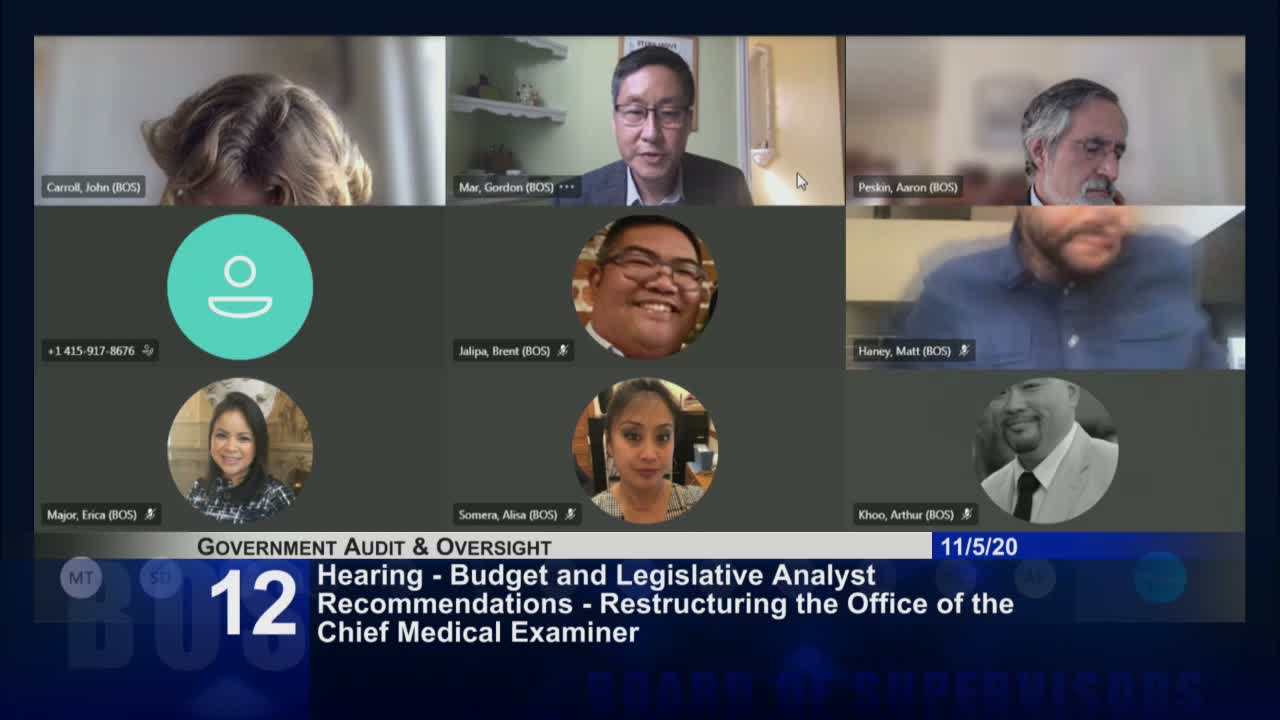
Committee Chair Supervisor Gordon Marr and colleagues Aaron Peskin and Matt Haney voted to send the POA MOU to the Board without a recommendation. Chair Marr said the Board’s role is limited to accepting or rejecting MOUs brought to it, and that the panel would continue hearings about meet-and-confer procedures and other reforms before making a final judgment at the full Board meeting.
The agreement would defer some scheduled wage increases for police and fire, extend contract terms and include a parity (“me-too”) clause tying some future increases for the POA to broader citywide wage actions. Controller Ben Rosenfield told the committee that, taken together, the MOUs before the committee would save about $12 million in the first year but could increase costs in later years, with projected higher costs in FY22–23.
Director of Employee Relations Carol Eisen defended the bargaining approach and said legal limits constrain the city’s options in labor negotiations. “Meet and confer or negotiations…is enshrined in state law,” Eisen said, arguing that the city cannot force a union to waive statutory meet-and-confer rights and that policy matters are generally vested with the Police Commission. She warned that embedding broad policy changes in a multi-year MOU can create inflexibility for future reforms.
Many callers urged a different approach. Public commenter Dylan Davis said: “Reject the Police Officers Association contract renegotiation — renegotiate it in public.” David Risk of the Bar Association told the committee the MOU “is flawed and it is an impediment to reform,” urging supervisors to use their legislative authority to narrow what the POA may require to be meet-and-conferred.
Representatives of the police department acknowledged the public pressure and described steps they say will speed reforms. DHR and department leaders said they will work with the Board, the Police Commission and other stakeholders on process reforms, including hearings the chair has called to examine DHR’s meet-and-confer practices.
The committee’s vote moved the POA MOU to the full Board for consideration on Nov. 17, 2020. The committee also recommended by positive report several other MOUs (items 4–11) that defer wages for certain bargaining units and adjust terms; those recommendations likewise go to the Board for final action.
Next steps: the Board of Supervisors will take up the POA MOU on Nov. 17, where members may accept or reject it; supervisors said they plan additional hearings on meet-and-confer and transparency in the interim.