Get Full Government Meeting Transcripts, Videos, & Alerts Forever!
Get email alerts on the City Budget topic
No spam. Unsubscribe anytime.
Mayor—s budget office flags roughly $420 million two-year shortfall and orders efficiency targets
Summary
The mayor—s budget office told the Board of Supervisors Budget & Appropriations Committee the joint five-year financial plan shows an approximate $420 million two-year deficit and instructed general-fund departments to propose efficiency and reduction options (3.5% rising to 7%) while prioritizing housing, shelter and services for people living on the streets.
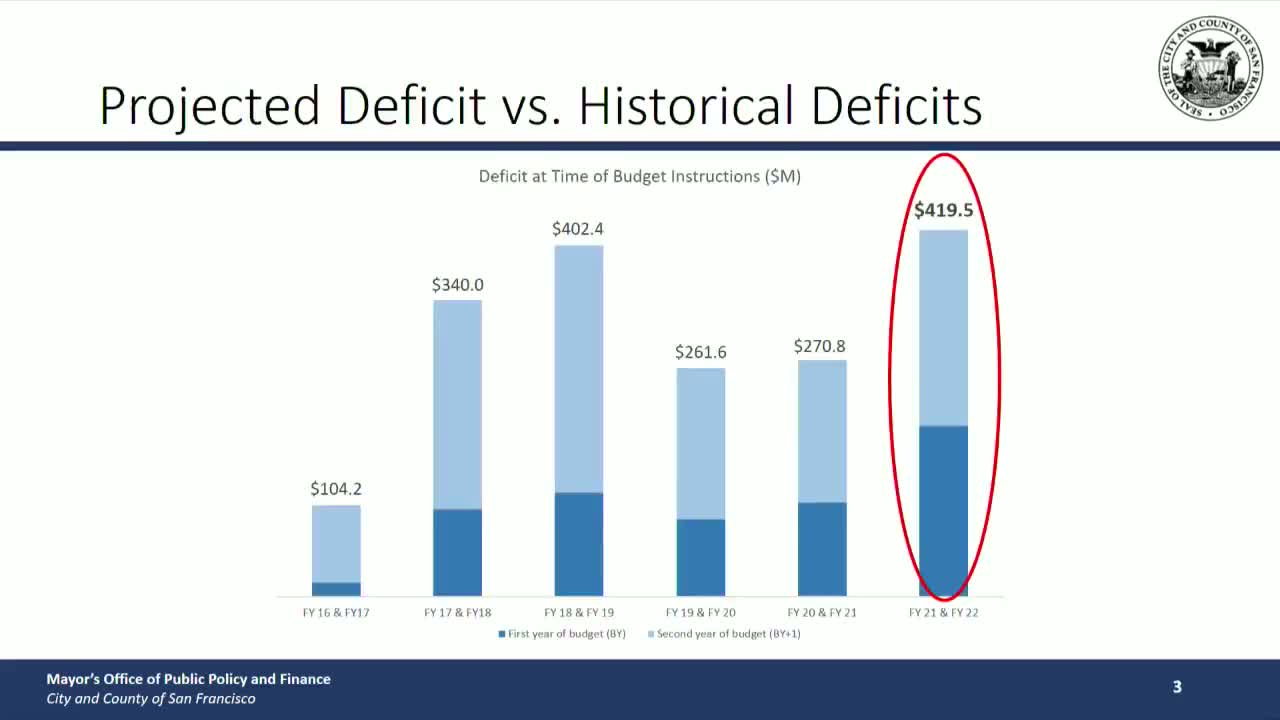
Kelly Kirkpatrick, the mayor—s budget director, told the Budget & Appropriations Committee on Feb. 5 that the city—s joint five-year financial plan projects roughly a $420,000,000 two-year deficit and that revenue growth is slowing while expenditures continue to outpace it.
"It is approximately $420,000,000 2 year deficit," Kirkpatrick said, and added the gap is meaningfully higher than recent budget cycles, which had two-year deficits nearer $270,000,000. She attributed the larger shortfall to moderated revenue growth and rising personnel and benefit costs.
The presentation said revenues are projected to grow at about 7% over the forecast while expenditures were illustrated at a steeper pace in the office—s slides. Kirkpatrick highlighted several expenditure drivers: negotiated wage increases, rising pension contributions, and health-care cost inflation. The report uses an inflation assumption of roughly 3% per year for non-personnel costs and assumes health benefits will increase about 6% annually.
Kirkpatrick also explained that certain one-time or restricted revenues are not counted as general-purpose budget relief in the baseline forecast. In particular, she said the Educational Revenue Augmentation Fund (ERAF) receipts for fiscal 2020—21 were not included in the deficit because the office assumes those dollars will be spent in designated, largely one-time ways. She said the plan anticipates about $230,000,000 in ERAF for FY20—21, of which roughly $180,000,000 would be discretionary under the previously adopted allocation rules.
The presentation stressed that some current-year transfer-tax windfalls from very large property sales will be reported in the controller—s six-month update and are expected to flow mostly into a budget stabilization reserve rather than be counted as recurring revenue for future-year forecasts.
Faced with the structural pressures, Kirkpatrick said the mayor instructed general-fund departments to submit "target efficiency and reduction" proposals (a target set at 3.5% and growing to 7% in the presentation) that prioritize core services, minimize frontline impacts and avoid layoffs where possible. Departments were also asked not to load new general-fund positions or budget enhancements during the current department phase and to use budget process improvement tools, including publicly noticed departmental budget hearings.
Supervisor questions focused on historical projection errors (committee members asked for a March comparison of six- and nine-month revisions), whether health-cost and pension assumptions are locally elevated, and how special-purpose ballot measures such as Prop C and Prop G are treated. Kirkpatrick and Michelle Laresma of the controller—s office said the special-purpose taxes are handled outside the general-fund baseline because their revenues are legally dedicated to specified expenditures; any ERAF repayments tied to those measures would be processed only if the revenue is validated through the court process.
The committee filed the item without objection at the conclusion of the discussion. The mayor—s office said it will return with a March update and additional detail requested by supervisors.
Ending: The mayor—s budget office will present a March six-month update to the committee with revised fund-balance and revenue data; departments were directed to return proposals in line with the mayor—s priorities and the committee requested comparative charts showing prior-year projections versus actuals.