Get Full Government Meeting Transcripts, Videos, & Alerts Forever!
Get email alerts on the Thermal Networks topic
No spam. Unsubscribe anytime.
Advocates push thermal energy networks and a dedicated 'green HECAP' to decarbonize campuses
Summary
Environmental and building‑decarbonization advocates urged lawmakers to fund campus‑scale thermal energy networks (TENS), citing potential long‑term savings, waste‑heat capture and job creation; independent colleges advocated a 'green HECAP' stream to support smaller decarbonization projects.
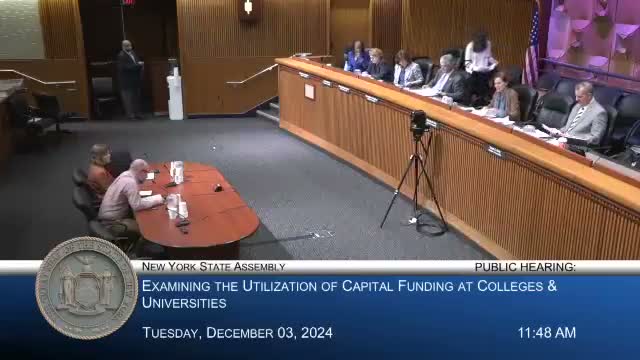
Advocates from the New York League of Conservation Voters and the Building Decarbonization Coalition told the Assembly Higher Education Committee that campus‑scale thermal energy networks (TENS) — systems that use geothermal bore fields, waste heat and heat pumps on a campus loop — can deliver larger carbon reductions and cost savings than piecemeal building‑by‑building conversions.
Jonathan Furlong (NYLCV) described TENS as "models that can be scaled up in cities" and urged dedicated yearly funding for large‑scale network projects at SUNY campuses such as Purchase and Buffalo. Allison Considine (Building Decarbonization Coalition) said networks can leverage waste heat from data centers and access economies of scale that reduce grid upgrades and operating costs.
Advocates provided a payback example: Colorado Mesa University’s geothermal loop, in operation since 2008, yielded a roughly 12‑year payback and now produces ongoing annual energy savings on the order of $1.5 million. Witnesses said campus‑scale projects are more likely to avoid major distribution upgrades that would be needed if campuses relied solely on electric resistance heating for decarbonization.
Tom Schnur (Commission on Independent Colleges and Universities) recommended creating a "green HECAP" stream to fund decarbonization and small‑scale retrofits that do not fit the traditional HECAP model. Schnur also urged timing changes so the three‑year completion clock in HECAP grants begins after awards are announced; he argued that delayed notifications have forced campuses to decline awards because projects cannot be completed within the statutory window.
Panelists emphasized workforce benefits and labor standards: advocates and unions in the Upgrade New York coalition recommend project labor agreements and recruitment from disadvantaged communities, arguing that predictable programmatic funding would allow apprenticeship pipelines to scale.
Ending: Advocates asked the Assembly to consider earmarked capital for thermal energy networks and to coordinate state agencies, utilities and labor partners to convert master plans into shovel‑ready projects.