Get Full Government Meeting Transcripts, Videos, & Alerts Forever!
Get email alerts on the Suny Capital topic
No spam. Unsubscribe anytime.
SUNY warns of $8.9 billion maintenance backlog, urges predictable capital to fund decarbonization
Summary
SUNY officials told the Assembly Higher Education Committee the system faces roughly $8.9 billion in deferred maintenance, aging facilities and rising construction costs, and said predictable, multiyear capital funding is needed to pursue electrification and campus‑scale sustainability projects.
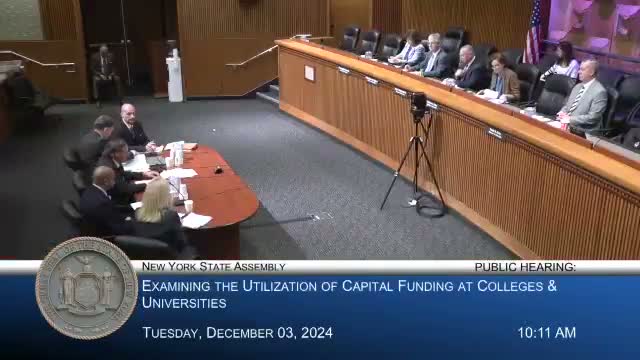
Assemblywoman Pat Fahey convened the Higher Education Committee hearing with testimony from State University of New York (SUNY) officials who framed capital funding as central to both campus safety and long‑term energy savings. "We were able to provide $2,000,000,000 in funding for our public university system, including, that included $1,400,000,000 for SUNY and $481,000,000 for CUNY," Fahey said in opening remarks, noting recent budget investments.
Bob Halen, senior vice chancellor (State University Construction Fund), told the committee SUNY manages roughly 1,800 buildings across about 63,000,000 gross square feet and that the system faces an "almost tripled" deferred‑maintenance estimate of $8,900,000,000. He said predictable capital allows projects to be phased ("dollars 1 in design drives $6 in construction") and that the system has a 10‑year planning outlook for state‑operated campuses.
Halen and other SUNY witnesses described recent cost pressures: construction costs have risen roughly 40% since the pandemic because of supply‑chain constraints, inflation and higher labor costs. That combination, they said, makes one‑time appropriations difficult to use for multiyear design‑to‑build pipelines and impedes predictable scheduling.
Panelists emphasized linking critical maintenance with sustainability investments. Carter Strickland, SUNY’s chief sustainability officer, outlined projects including geothermal wells at several campuses and noted that federal programs such as the Inflation Reduction Act require states to front project costs and seek reimbursement. "The way the Inflation Reduction Act works is the state has to put the money upfront, then we get paid back," Strickland said, adding that federal amounts to date are modest compared with system needs.
Committee members pressed SUNY on prioritization for campuses with immediate equipment failures and on how electrification affects capital needs. SUNY said it uses a data‑driven rating system to prioritize campuses with recurrent failures and estimated that adding certain sustainability measures could increase project costs by about 20% while producing long‑term operating savings through reduced energy use.
The hearing also covered specific facilities: SUNY and members discussed Upstate Hospital’s capital needs and an advisory board formed to assess downstate institutions; SUNY said consultants are developing scopes and cost estimates but that the advisory process and timing for any larger appropriation remain unsettled. On campus footprint, SUNY staff said the system is seeing pockets of excess capacity that some campuses want to address through demolition and rightsizing, but demolition requires capital outlays and thus competes with other critical maintenance needs.
The committee closed the session by inviting additional documentation from SUNY (including clean energy master plans and project cost estimates) and by indicating the hearing’s findings will inform budget deliberations in the coming cycle.
Next steps: SUNY will provide follow‑up materials on campus prioritization and Upstate Hospital assessments; members signaled interest in turning testimony into budget proposals that better align predictable capital with sustainability goals.