Get Full Government Meeting Transcripts, Videos, & Alerts Forever!
Get email alerts on the Budget topic
No spam. Unsubscribe anytime.
South Orangetown budget outlook focuses on reserves, enrollment decline and electric-bus questions
Summary
District business official gave a budget calendar and fiscal overview, citing a roughly $4.4 million unrestricted fund balance, a demographer's projection of about 29 fewer students next year and uncertainty around the state's Foundation Aid review; board members pressed staff on electric-bus costs and vendor readiness.
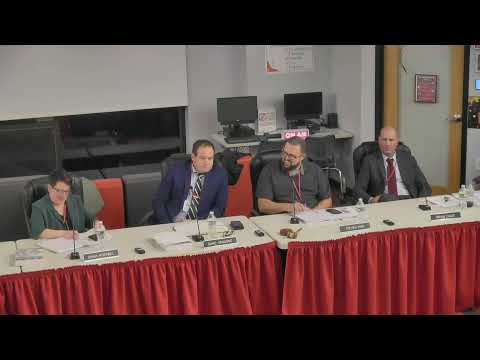
The South Orangetown Central School District on Tuesday laid out its budget-development timeline and fiscal position as board members pressed staff for more detail on enrollment trends and the costs of an electric school-bus transition.
Assistant Superintendent for Business and Operations Miss Espinal told the board the budget is the district's "educational plan in numbers," explaining that major revenue sources are the local tax levy and state aid while typical expenditures include salaries, benefits, debt service and contracts. She said the district's unrestricted fund balance stood around $4,400,000, which she described as "within the preferred limit established by the New York State Comptroller's office." She noted audited reserves exist but explained reserves cannot be spent without board approval or a voter proposition.
The presentation included a demographer's projection that estimates about 29 fewer students across K'12 next year. Espinal cautioned that because the decline is spread across grades it does not necessarily translate into elimination of a single class, but enrollment figures will factor into staffing decisions. She said budget documents will be developed with three statutory components: administrative, programmatic and capital.
The board was given a calendar for the budget cycle: administrative templates and building-level budget meetings in December, a preliminary budget presentation on March 11, adoption April 8, a public hearing on May 13 and the budget vote on May 20. Espinal said the district will present estimated state aid and tax-cap calculations during a Jan. 28 meeting and hold workshops in January and February.
The district and trustees flagged uncertainty from a state review of the Foundation Aid formula. Espinal summarized a report recommending modernization of poverty measures, accounting for regional cost differences, and possibly shifting some funding for English-language learners from the Foundation Aid formula into categorized (expense-driven) aid. "It's kind of in a gray area right now," she said, and board members said they were concerned that changes could adversely affect districts in the Lower Hudson.
Trustees also pressed staff about the state's timetable for electric buses and the local costs of converting fleets and installing charging infrastructure. Espinal and the superintendent said the mandates present a significant undertaking for districts and contractors, noting hardware and infrastructure costs, charging logistics, driver and maintenance capacity, and shifting statewide deadlines. One board member said the state's numbers "just don't add up," and the district plans to consult vendors and observe early local adopters before committing to large capital outlays.
Next steps include more detailed revenue estimates in late January and site-level budget reviews in December; trustees asked staff to include transportation cost scenarios and explicit assumptions about state-aid changes in upcoming reports.
The board's consent agenda passed earlier in the meeting; the budget schedule and more-detailed numbers will be the subject of upcoming workshops and presentations.