Get Full Government Meeting Transcripts, Videos, & Alerts Forever!
Get email alerts on the Ai Regulation Debate topic
No spam. Unsubscribe anytime.
Industry and civil-rights groups clash at Assembly hearing over AI rules, audits and liability
Summary
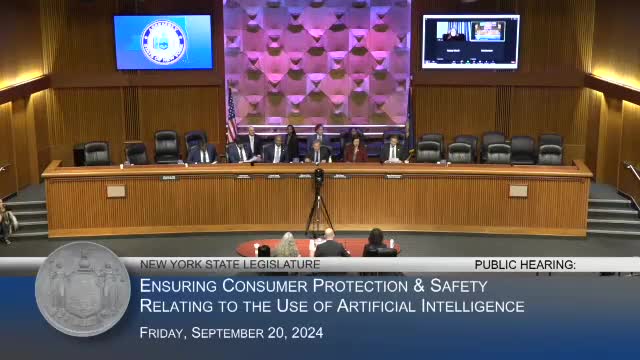
At an Assembly joint hearing, IBM and trade groups urged risk- and use-based rules and warned against licensing regimes; civil-liberties groups and consumer advocates urged broad transparency, liability frameworks and stronger enforcement, including court-protected discovery and burden-shifting for biased systems.
Tech companies, industry associations, civil-rights organizations and consumer groups spent much of the Assembly hearing debating the right regulatory approach to artificial intelligence.
Rosalyn of IBM told the committees that "policy makers should look at whether the situation in which [AI] is used may be constructed as high risk," arguing that regulation should target risky use cases rather than underlying algorithms. IBM's witness described company governance practices (ethics boards, integrated impact assessments and model cards) and cautioned that licensing regimes could entrench incumbents and stifle innovation.
Representatives of the Chamber of Progress and Tech NYC urged a sector-by-sector, application-layer approach, warning that overly broad model-level rules could create compliance burdens and chill startups. "Regulate harms, not technology," a Chamber of Progress witness said, recommending targeted updates to existing statutes.
Civil-rights and consumer-advocacy witnesses pushed back. Daniel Schwartz (New York Civil Liberties Union) and Casey Mach (Center for Humane Technology) urged broad transparency, impartial impact assessments and legal pathways to enforce rights, including mechanisms to ensure discovery and to hold developers accountable for harmful or reckless model releases. Mach recommended a duty-of-care framework for developers and pointed to Vermont House Bill 711 as a reference model.
Speakers across panels debated the practicality of audits. David Sifford (Surveillance Technology Oversight Project) warned that private bias audits lack standardization and that courts and discovery rules must allow independent review of models under protective orders so affected people can make enforcement claims.
The hearing surfaced repeated tradeoffs: defender's arguments that heavy-handed, model-level constraints risk damaging innovation and market competition, and advocates' argument that without stronger liability and disclosure, harms will go unremedied. Lawmakers asked for technical follow-up from witnesses and staff.
No bills were passed at the hearing; members signaled interest in drafting targeted statutory changes and in convening further technical working sessions.