Get Full Government Meeting Transcripts, Videos, & Alerts Forever!
Get email alerts on the Funding And Administration topic
No spam. Unsubscribe anytime.
Lawmakers probe costs, oversight and which agency should run a statewide supervised‑visitation program
Summary
At a joint Assembly hearing, judges and providers said startup costs vary and urged statewide contracting, certification and enforceable reporting; witnesses debated whether OCFS or the Office of Victim Services should administer funds and discussed Medicaid, sliding‑scale fees and possible pilot models.
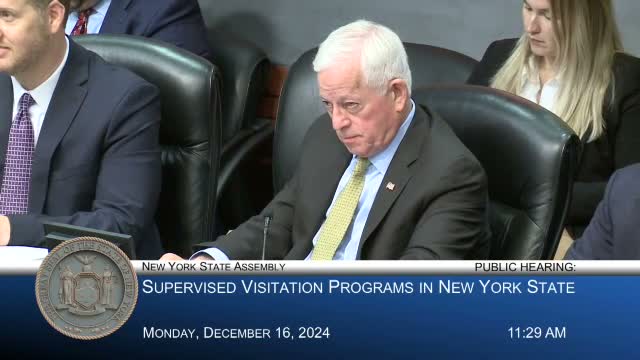
Lawmakers pressed judges and service providers at a joint Assembly hearing about the costs and administrative design of a potential state‑funded supervised‑visitation initiative.
Judge Richard Rivera cited an OJI report estimating startup costs at roughly $200,000 per new program (about $3,000 per family for six months) and said ongoing program costs are often estimated in the $2,500–$3,000 range per family. He gave a local example of a Capital District program that received a $273,000 grant and could add one 20‑hour/week staffer; a Rensselaer County program charges about $150 for a 90‑minute visit.
Assemblymembers sought a statewide price tag if programs were seeded in nearly 30 counties that currently lack services. Speakers emphasized the difference between startup seed money and sustainable operating funds, and several witnesses urged an RFP model that contracts with nonprofit providers rather than building a single centralized delivery agency.
Witnesses debated which state agency should oversee grants and regulation. Liberty Aldrich and other advocates suggested the Office of Victim Services (OVS) as a home for the initiative because of its trauma‑informed oversight and standards, while others noted the Office of Children and Family Services (OCFS) had been contemplated in past bills. Panelists recommended that any administering agency require standardized training, reporting protocols, regular audits and penalties for noncompliant providers.
Speakers also discussed possible revenue and cost‑reduction approaches: sliding‑scale fees tied to income and public‑defender eligibility; pilot projects to refine scope; use of existing local infrastructure (courthouses, schools, community centers) to reduce facility costs; and targeted use of Medicaid Child and Family Treatment Support Services where clinical criteria are met. Ronald Richter of JCCA explained that Medicaid mechanisms exist but that billing rates and logistics make broad integration challenging without system changes.
Committee members asked for further data collection to quantify unmet demand, better cost modeling for statewide rollout, and options to prioritize families most in need if funding proves limited. No appropriation or final administrative decision was made at the hearing; members requested follow‑up materials and cost estimates.