Get Full Government Meeting Transcripts, Videos, & Alerts Forever!
Get email alerts on the Supervised Visitation topic
No spam. Unsubscribe anytime.
Judges, advocates tell Assembly New York lacks supervised‑visitation programs in 28 counties; $20M funding ask proposed
Summary
Judges, legal advocates and service providers told a joint Assembly hearing that professionally supervised visitation and safe‑exchange programs are scarce across New York, leaving families on months‑long waitlists. Witnesses urged state funding, oversight and training; a working group recommended $20 million to expand services.
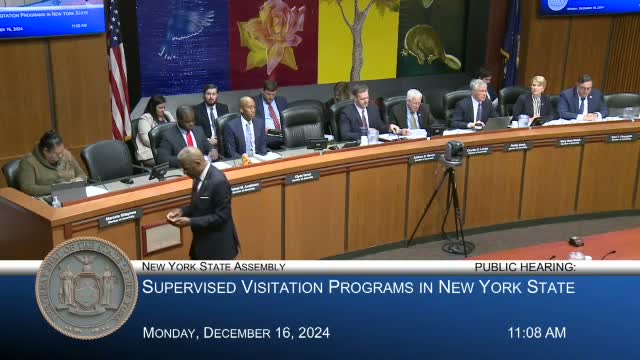
Assembly leaders convened a joint hearing of the Assembly Standing Committees on the Judiciary and on Children and Families to examine access to supervised visitation programs ordered by family courts and how New York should resource and regulate them. Judges, legal advocates and nonprofit service providers testified that professionally staffed supervised‑visitation and safe‑exchange programs are severely limited statewide and that gaps are driving delays in custody and visitation cases and harming children.
Judge Richard Rivera, the statewide coordinating judge for family‑court matters, told the committees that a July 2023 working‑group report and a 2024 Unified Court System update show growing service gaps: programs are absent in many counties, waitlists are long, and where services exist they are often costly, limited in hours, and lack language access and transportation supports. "The lack of supervised visitation and exchange programs . . . derives delays in resolving cases and . . . does harm children and families before the courts," Rivera said.
Witnesses described concrete shortages. Judge Anne Marie Jolly said some programs only supervise a few visits and have months‑long waits; judges cited instances where children went months without seeing a parent because supervised visits were unavailable. Betsy Kramer of Lawyers for Children recounted cases in which families remained on waitlists for five months or longer, delaying court dispositions and eroding children’s relationships with parents.
Service providers and advocates outlined policy options. Liberty Aldrich of the Children’s Law Center said a citywide working group recommended a $20,000,000 state investment to expand existing programs and create new ones, and urged that funding be paired with statewide protocols, training and enforceable oversight. Panelists recommended contracting with nonprofit providers, building a continuum of services (professional centers, trained social‑work observation and trained family supervisors), and ensuring interpretation and transportation supports for low‑income and multilingual families.
Committee members asked detailed questions about who should administer a state initiative. Witnesses debated housing the program in the Office of Children and Family Services (OCFS) versus the Office of Victim Services (OVS); several witnesses favored OVS because of its expertise and oversight structures for trauma‑informed services but said any administering agency would need standardized reporting, certification and penalties for noncompliance.
The hearing did not produce a final legislative action; rather, members requested follow‑up data and cost estimates and heard several concrete proposals for next steps, including pilot projects, RFP‑driven contracts with nonprofits, sliding‑scale fees, and options to leverage Medicaid where clinically appropriate. The committees closed the hearing with thanks to judges, advocates and providers and signaled continued work on funding and oversight design.