Get Full Government Meeting Transcripts, Videos, & Alerts Forever!
Get email alerts on the Scr System Reform topic
No spam. Unsubscribe anytime.
Assembly hearing spotlights reforms to New York's State Central Register
Summary
Assembly committee hearing examined how the Statewide Central Register (SCR) screens reports of child abuse and maltreatment. OCFS and ACS described operations and data; advocates and impacted parents urged confidential reporting, stronger screening tools, and limits on prenatal-based reports.
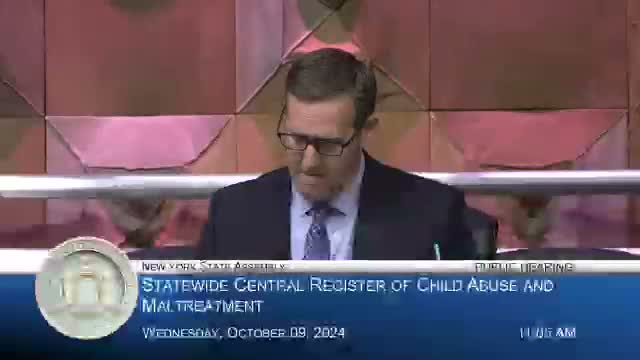
Chair Andy Hevesy opened the Assembly Committee on Children and Families hearing by asking officials to treat the session as information sharing, not an adversarial inquiry. He introduced OCFS Commissioner Damia Harris Madden and Deputy Commissioner Gail Geohegan Pratt, who described the SCR as the "front door" that receives calls 24 hours a day, 7 days a week.
The Office of Children and Family Services told the committee the SCR received more than 300,000 calls in 2023 and that specialists undergo a multi‑stage training regimen — six weeks of classroom work followed by supervised live calls and a 12‑month probationary period. Commissioner Harris Madden said supervisory review and a dedicated quality‑assurance team monitor screening decisions and that OCFS has implemented the OCFS HEARS help line to divert callers to services; the HEARS line has handled about 4,200 calls to date.
Committee members pressed OCFS on legal screening thresholds — "reasonable cause to suspect," "imminent danger," and "minimum degree of care" — and on how subjective elements like "minimum degree of care" are taught to specialists. OCFS officials said the statutory elements guide whether a call is registered as a report and described real‑time supervisory consultation when specialists have doubts.
The hearing also focused on data and transparency. Several witnesses and members urged OCFS to align and report SCR screen‑out data to the federal NCANDS system and to publish annual breakdowns by county and reporter type so analysts can see where investigations are concentrated. OCFS acknowledged state/federal coding differences and said it is reviewing how to improve comparability.
Beyond agency testimony, a wide range of advocates, legal defenders and people with lived experience urged legislative changes: ending anonymous hotline calls in favor of confidential reporting, creating a secondary review or local discretion to close clearly inappropriate referrals, expanding closure codes to reflect statutory reasons (including when a report is rejected because a parent shows a minimum degree of care), and curbing prenatal toxicology‑based referrals. New York City ACS Commissioner Jess Danhauser told the committee ACS responded to about 60,633 SCR reports last year and described CARES (an alternative response track) as a tool to reduce intrusive investigations in appropriate cases.
Advocates and survivors emphasized two recurring themes: that anonymous or malicious calls can be weaponized against families (particularly survivors of domestic violence) and that many SCR‑referred investigations are ultimately unfounded, producing substantial trauma to children and parents. Legal and child‑welfare organizations recommended concrete reforms: structured screening questions for hotline operators, expanded QA and data publication, pilot programs for secondary review, and statutory protections such as the Family Miranda Rights Act and an informed‑consent law for prenatal drug testing.
The committee closed the hearing with an agreement to follow up on several items, including data publication, closure codes, and piloting local secondary review models. The testimony set a broad agenda for legislative and administrative action to narrow the SCR "front door" while preserving the system's role in identifying children at risk.