Get Full Government Meeting Transcripts, Videos, & Alerts Forever!
Get email alerts on the Referendum topic
No spam. Unsubscribe anytime.
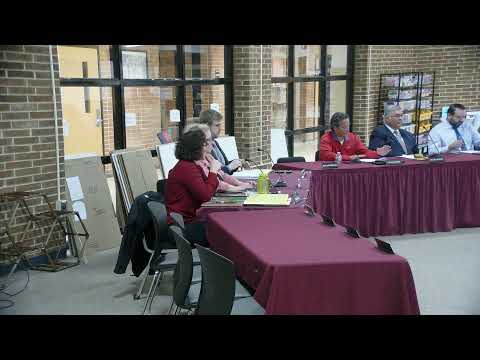
Moorestown board previews March 2025 referendum as State of the District spotlights achievement and gaps
Summary
Board officials said the district submitted 18 state construction applications totaling about $110,000,000 and will decide which projects to place on a March 2025 referendum once preliminary state funding eligibility letters arrive; Dr. Benton highlighted strong assessment results alongside subgroup performance gaps.
The Moorestown Township Board of Education on Nov. 19 said the district has submitted 18 separate construction applications to the state — projects the board estimated at approximately $110,000,000 — and that preliminary eligibility and cost letters from the state are expected early to mid‑December, a step officials said will shape what appears on a March 2025 referendum ballot.
“We have submitted 18 separate construction applications that relate to the project … and we are waiting to hear back from the state in terms of the amount of funding that the state will provide to the district to help offset some of those costs,” said the Board President, who led the meeting and outlined referendum logistics. Board officials said the district will then review which portions to present to voters and may divide work into one or multiple ballot questions.
Superintendent‑level staff said transition planning is under way: the current superintendent will depart in December and Dr. McNeely will begin in January, with a Dec. 4 district tour scheduled to introduce her to administrators and staff.
During the board’s annual State of the District presentation, Dr. Karen Benton reviewed assessment and program data across the district, saying Moorestown students generally outperform state averages in English language arts and that the district has increased AP participation and AP performance.
“We consistently outperform the state average each year,” Dr. Benton said while summarizing multi‑year assessment trends and curricular shifts, including adoption of new reading and math resources and expanded intervention staffing.
Benton also flagged disparities among student subgroups. Disaggregated results showed lower performance for Black, Latino and economically disadvantaged students and for some students new to the district; Benton said many of the students in lower‑performing groups had enrolled in the last two years and may not yet have benefited from the district’s sustained interventions.
The presentation listed a range of interventions the district is expanding: additional reading and math support teachers, a Wilson reading specialist serving grades 3–6, and piloting of Foundations and Into Math K–5 and new 6–8 curricula with professional development planned for March 2025 and a full K–5 rollout in the 2025–26 school year.
Benton noted the district’s performance on college‑readiness measures: expanded AP participation, a silver designation on the AP Honor Roll, and strong PSAT/SAT results compared with state and international benchmarks. She also reported that roughly 84% of graduates go on to two‑ or four‑year colleges and that an estimated 95% or better persist through their second year.
The district also completed a New Jersey Quality Single Accountability Continuum (QSAC/CUSAC) review — its first in 13 years — and was deemed a high performing district by county review, Benton said.
What happens next: board members said they expect to receive the state's preliminary eligibility letters in early to mid‑December; once those letters arrive the board will decide which eligible projects to place before voters in March 2025. The district will present the referendum plans to the Moorestown Planning Board for a courtesy review on Dec. 5.