Get Full Government Meeting Transcripts, Videos, & Alerts Forever!
Get email alerts on the Public Safety topic
No spam. Unsubscribe anytime.
Kennesaw work session spotlights police equipment purchases and public‑safety facility funding
Summary
Police and public safety items in the FY26 proposal include an approximately $10.322 million police budget request, replacement patrol rifles, sub‑guns and launchers for festival operations, and use of impact fees (about $2.2 million) toward a public‑safety facility project.
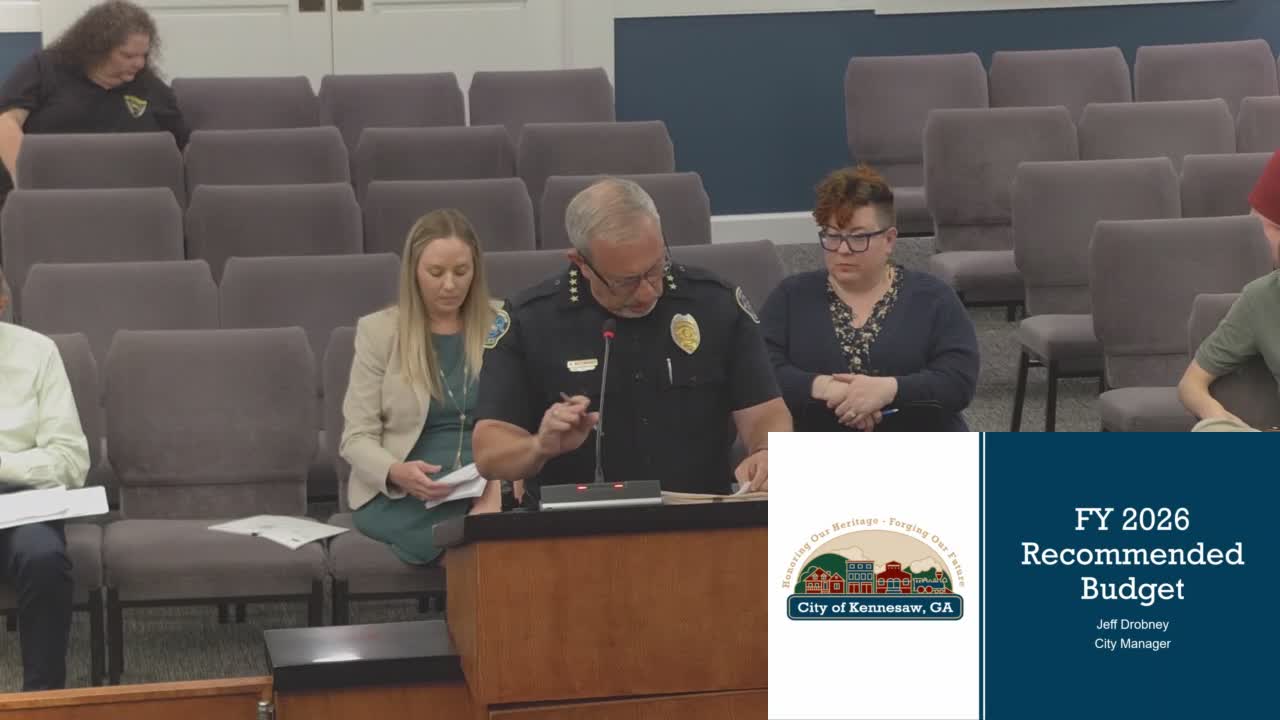
Police leadership presented a roughly $10.322 million budget request for FY2026 that includes a 3% COLA, overtime, training increases, and equipment purchases. The police presenter listed replacement sub‑guns used during festivals, 40mm launchers (described as utility, less‑lethal launchers) and $120,000 for replacement patrol rifles.
Speaker identified as police leadership said the request would cover 10 vehicles (six replacement patrol vehicles, three detective SUVs and one administrative vehicle for internal affairs) and noted the department currently has 86 authorized positions that will be maintained. Asset‑forfeiture revenues were reviewed; staff conservatively budgeted $20,000 and noted unpredictable annual forfeiture receipts.
The budget discussion also ties public‑safety facility funding to impact fees. Officials referenced $2.2 million in impact fees committed for the public‑safety facility. Jeff noted that impact fees were being used to support the facility and Adams Park lighting projects.
Why it matters: the equipment purchases and facility plans represent significant public‑safety capital and operating commitments for the city. Council asked clarifying questions about the nature of weapons (e.g., whether rifles are semiautomatic) and use of reserve/impact funds for capital spending.
Staff emphasized financing mechanics: vehicle costs are normally structured through capital leases across multiple years rather than as single‑year cash payments.