Get Full Government Meeting Transcripts, Videos, & Alerts Forever!
Get email alerts on the Annexation Rezoning topic
No spam. Unsubscribe anytime.
Conyers council assigns zoning to annexed parcels; one business owner objects to tax impact
Summary
After staff presentations and public hearings, the council approved four rezoning ordinances to assign zoning to parcels annexed into Conyers; a Millstead Road medical-practice owner urged council to reconsider the zoning because of projected city taxes.
The Conyers City Council on June 4 approved a package of rezoning ordinances to assign zoning classifications to properties annexed into the city earlier this year.
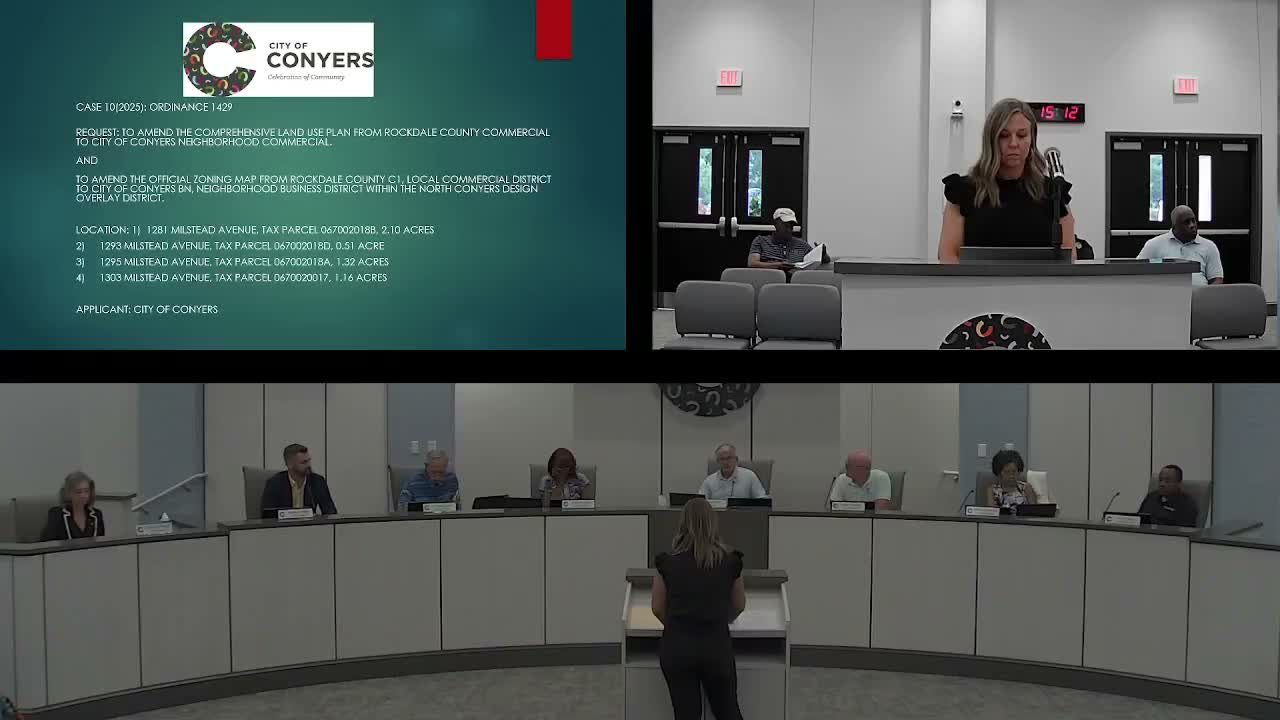
City planning staff told the council the annexations were authorized by state legislation and take effect July 1; the June 4 public hearings addressed only which City of Conyers zoning categories to assign to the parcels. Staff recommended neighborhood business (BN) zoning for a cluster on Milstead Avenue (Ordinance 14-29), office-institutional (O&I) zoning for several Millstead Road parcels (Ordinance 14-30), mixed-use development (MXD) for properties on Old Covington Highway (Ordinance 14-31), and Gateway Village/Urban Village subarea zoning for a set of parcels along Old McDonough, Old Salem and Highway 138 (Ordinance 14-33). Staff cautioned that some properties may be legal nonconforming uses under the new zoning; nonconforming uses may continue until discontinued for statutory periods (180 days in some cases, six months in others) but may not be enlarged.
During the Millstead Road hearing, Veronica Garrett, a local medical-practice owner, spoke in opposition concerning 1415 Millstead, saying her current annual tax burden is roughly $40,000 and that she feared city taxes would be “unsustainable” and could force her practice to close. The mayor and staff offered to provide property-specific tax estimates after the meeting; council did not change the proposed zoning. Several councilmembers emphasized that the hearings were about zoning only and that annexation had already been completed by the state action the city described.
All four ordinances were moved, seconded and approved by voice vote. The council waived second readings where requested and adopted the updated comprehensive land use map and official zoning map to reflect the annexations.
What’s next: affected property owners should receive follow-up from city staff about licensing and tax details; nonconforming businesses were told they may continue to operate under current use rules unless the use ceases for the statutory period.