Get Full Government Meeting Transcripts, Videos, & Alerts Forever!
Get email alerts on the Budget Finance topic
No spam. Unsubscribe anytime.
Fulton County Schools warns of shrinking fund balance; finance chief outlines $93M–$95M GLIDE plan
Summary
Fulton County Schools CFO Marvin Doreef told the board the district faces rising costs and declining revenue, projecting fund-balance stress by the end of the decade and unveiling a GLIDE strategy aiming to generate $93–$95 million between FY2027–2030 to close projected gaps.
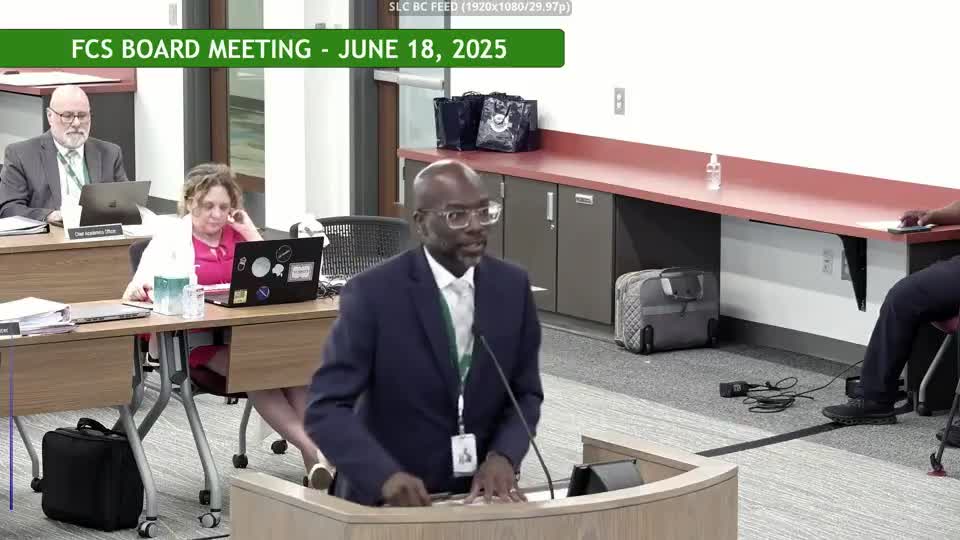
Marvin Doreef, Fulton County Schools’ chief financial officer, told the school board on June 18 that rising costs and falling state revenue threaten the district’s fund balance and that staff have launched a multi-year strategy to address a projected budget gap.
"It does not show what will happen, but what might happen if we don't act," Doreef said as he presented the district’s long-term forecast and the GLIDE plan, an acronym staff described as growth, lean operations, invest in innovation, diversify revenue and enhance efficiency.
The presentation flagged several cost pressures and revenue constraints: health insurance costs have risen sharply (reported in the presentation as a roughly 99.47% increase over the past four years), the Teachers Retirement System contribution (TRS) rose about 21.9% in the same period, and special-education costs increased roughly 41.5% over four years. Board members and staff said FTE (full‑time‑equivalent) enrollment counts are down, contributing to reduced state revenue. Doreef said the district’s beginning and ending fund balances are declining in the forecast and that the ending fund balance is projected to be in the red around FY2029 under current assumptions.
As a target, the GLIDE adjustments aim to collectively produce roughly $93,000,000 to $95,000,000 between fiscal years 2027 and 2030 through a mix of revenue enhancements and expenditure reductions, Doreef said. Staff outlined a calendar of work: data collection and interviews through June, deep‑dive analysis in July, drafting option lists in August and producing a budget primer by Sept. 30 for board consideration in October.
Board members asked for a plain‑language one‑ to two‑page summary for the public explaining the district’s funding mix and the forecast's drivers. "Putting this in layman's terms that anyone understands" was a repeated request, a board member said.
Doreef and other presenters emphasized the forecast is a planning tool, not a decision: staff will return with analysis, options and implications — including which savings are recurring and which are one‑time — so the board may weigh tradeoffs as it develops the FY2027–FY2030 budget approach.
Next steps: staff will continue data analysis, finalize the budget primer by Sept. 30 and present options to the board in October.