Get Full Government Meeting Transcripts, Videos, & Alerts Forever!
Get email alerts on the Parks Recreation topic
No spam. Unsubscribe anytime.
Tucker council advances Rosenfeld Park court renovation amid pickleball noise, parking and design debates
Summary
Council heard staff plans to demolish and rebuild tennis courts at Rosenfeld Park to fix erosion, adding 8–10 off‑street parking spaces and new fence‑mounted lighting; members debated adding pickleball striping, sound mitigation and community engagement, and directed staff to reissue an RFP for the most recent design.
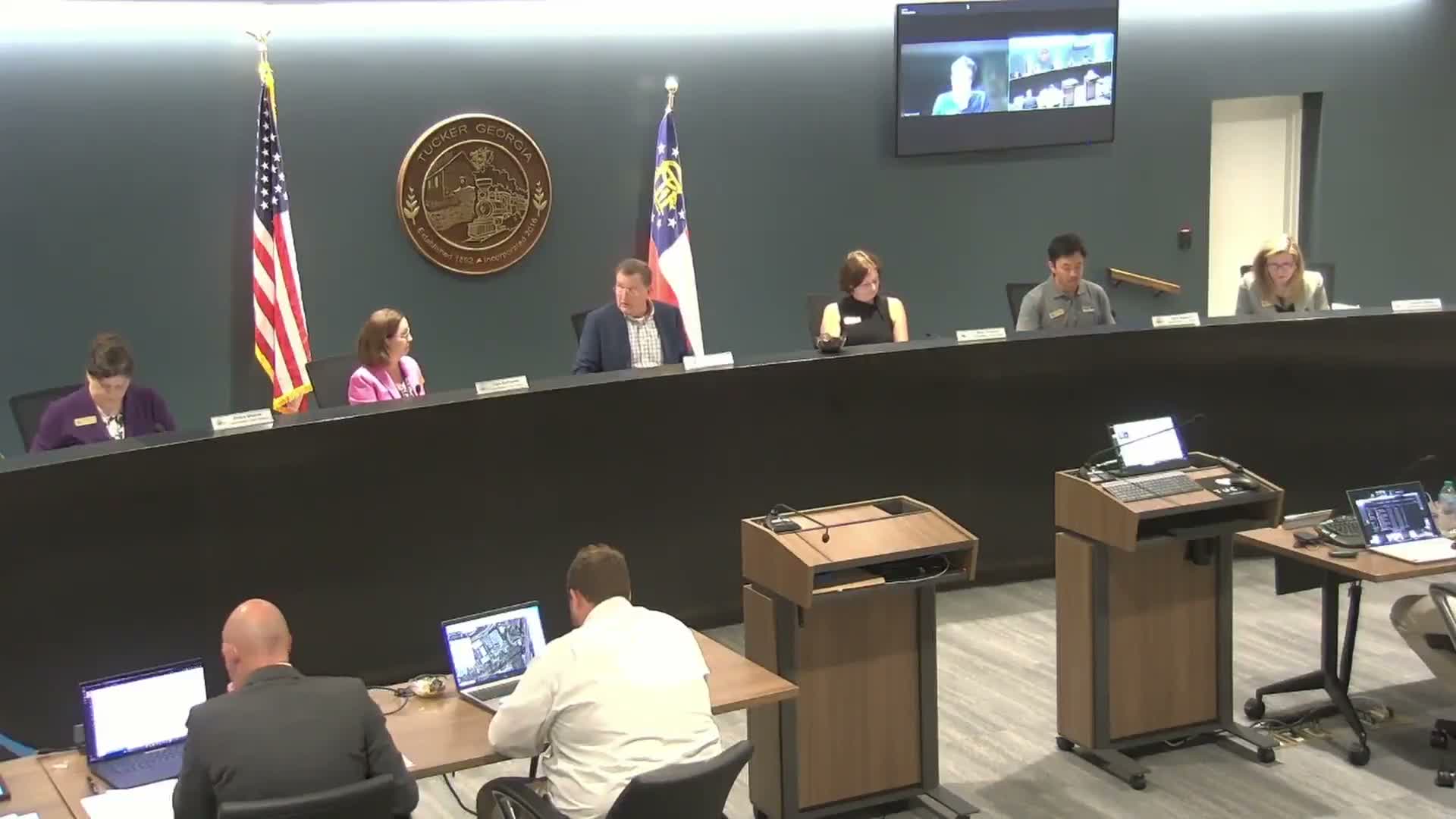
TUCKER, Ga. — The City Council on June 9 revisited plans to renovate the tennis complex at Rosenfeld Park, approving a move to seek formal contractor bids while council members pressed for clearer plans on parking, multi‑use play and sound mitigation.
City staff said the renovation is intended to address severe erosion under the existing courts, remove a failing retaining wall, reconstruct three tennis courts, add approximately 8–10 off‑street parking spaces, install fence‑mounted court lighting and restore proper stormwater controls. The city acquired the Smoke Rise Racket Club property in 2020 and earlier resurfacing revealed the underlying erosion problems, staff said.
“Once completed, the project will restore proper stormwater and erosion controls, reconstruction of three tennis courts, and approximately 8 to 10 off‑street parking spaces for the park,” the project presenter said, describing prior public input in 2022 and design approval in late 2023. Staff emphasized the project has not yet gone to bid and estimated a 9–12 month construction window once a contractor is selected.
Council members repeatedly asked whether the courts could be striped for pickleball; staff replied that striping could allow up to six pickleball courts and that sound mitigation could be added to the bid packet. “To make it shared use, it would just require striping for pickleball…which would allow for six courts,” a staff presenter said.
Concerns centered on amplified use, parking spillover into adjacent neighborhoods and how to manage sound. One council member asked whether the city could require a sound study; staff recommended engaging PSM (a firm noted by council) to perform a site‑specific sound and impact assessment and to hold an additional community meeting. “If that's a decision that council would like to make to explore multi‑use there, I would recommend that we contact PSM to come in and do a sound and impact assessment for us,” staff said.
Some members urged a citywide approach for racket sports, proposing a reservation system and consistency across parks so Henderson and other sites are upgraded in tandem. Others urged faster action to address current demand for pickleball and to provide interim playing options while Rosenfeld is offline.
Council ultimately approved a motion directing the city manager to reissue an RFP for the most recent Rosenfeld design so the city can obtain a lowest‑qualified bidder to consider; the motion passed 4–3. Supporters framed the step as necessary to get concrete cost estimates; opponents warned that the design should be revisited after additional community‑focused design work and sound‑mitigation modeling.
Next steps: staff will proceed with the RFP process and, per council discussion, can incorporate the results of a site‑specific sound assessment and additional community meetings into procurement or contract negotiations before any construction contract is executed.