
Mineola board hears capital plan and tentative $20 million bond signal to fund electric‑bus transition
Get AI-powered insights, summaries, and transcripts
Subscribe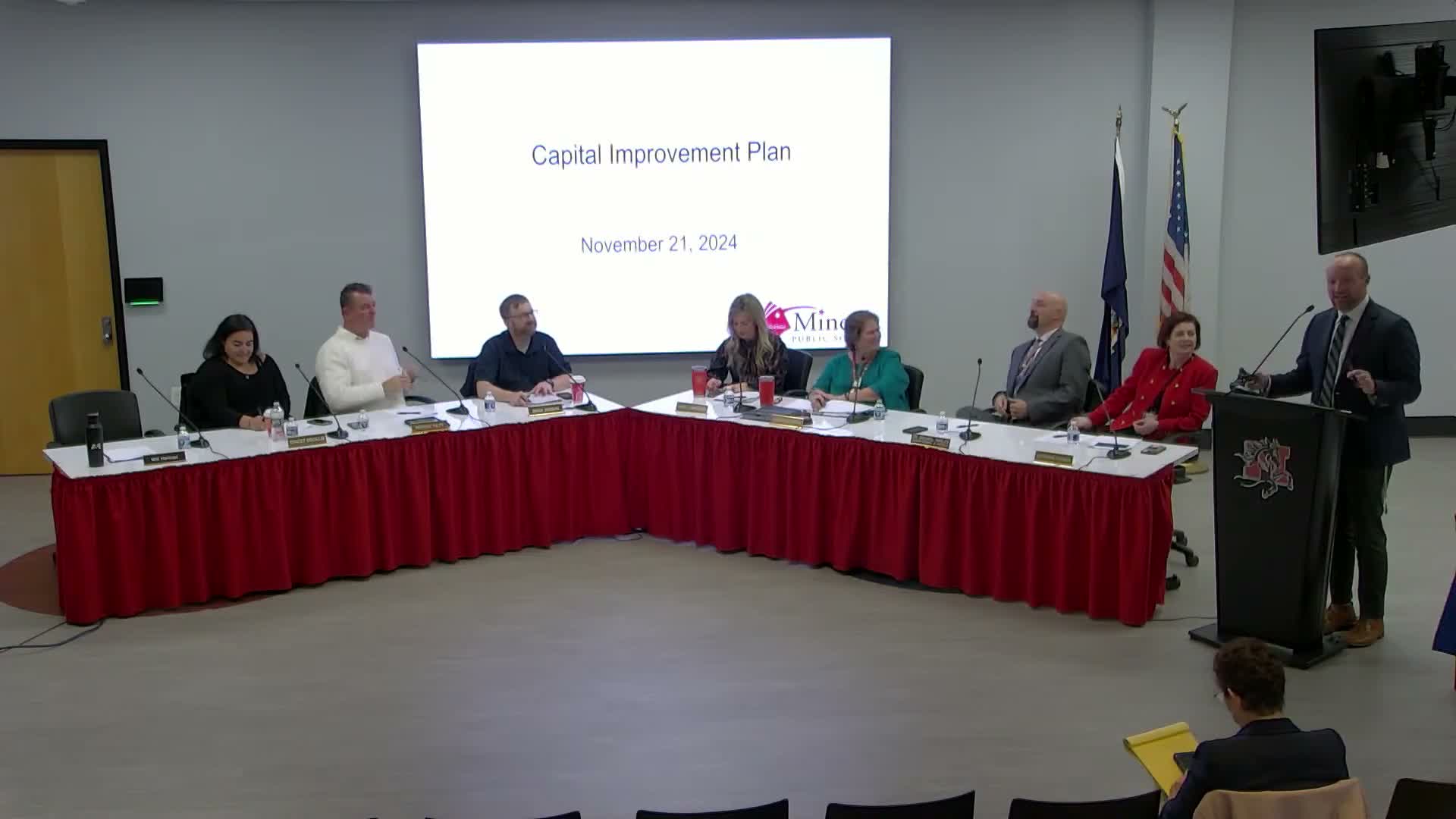
Summary
District staff outlined a five‑year capital plan and funding options; the superintendent said he is likely to recommend a bond in 2026–27 ("in the neighborhood of $20,000,000") to help pay for bus electrification, charging infrastructure and related facilities, pending studies and grants.
District finance staff and administrators presented the Mineola Union Free School District’s capital infrastructure (five‑year) plan at the Nov. 21, 2024 board meeting and walked trustees through how the district prioritizes projects and matches them to funding.
Assistant Superintendent Will Herman described the planning steps: conducting a building condition survey, aggregating facility needs, prioritizing projects and matching work to anticipated funding, with implementation and reprioritization as work proceeds. He told trustees that New York State requires a building condition survey every five years and that the district uses that work to inform its capital plan.
Herman explained funding sources the district uses: operating (general) fund line items, transfers to capital, a capital reserve (which generally requires voter approval), grants and debt instruments including tax‑anticipation notes, installment purchase agreements, energy performance contracts and bonds. He reported the district’s current annual debt service at about $2,350,000 (roughly 2–2.5% of the operating budget) and said Mineola historically carries relatively little debt.
Superintendent Michael Nabla addressed the board about the state’s 0‑emission bus requirements and the district’s likely response. "There’s a very good chance I’m going to recommend a bond in the year 'twenty six, 'twenty seven in the neighborhood of $20,000,000," Nabla said, characterizing the figure as a planning estimate tied to two major debt obligations dropping off the schedule in coming years. He and staff said the 0‑emission timeline (new buses purchased after 2027 must be zero‑emission; full fleet by 2035) creates timing and infrastructure needs that include chargers, increased electrical capacity, a garage/maintenance facility and possibly land purchase to relocate buses.
Trustees asked whether small buses are already gas and large buses diesel; staff replied that small buses and trucks are gas while large buses remain diesel. Administrators said a grant‑funded study is underway to assess whether the current bus yard can accommodate charging infrastructure; purchasing land could change funding choices (capital reserve vs. bond). Staff also described the practice of replacing debt that falls off the schedule with new debt of similar size (a "no additional impact" strategy) to avoid sudden levy spikes.
No vote on a bond was taken; trustees were asked to continue public engagement and to expect further study and a formal proposal should the administration recommend a bond.