
Mineola schools outline literacy-assessment plan, emphasize targeted interventions and cautious AI use
Get AI-powered insights, summaries, and transcripts
Subscribe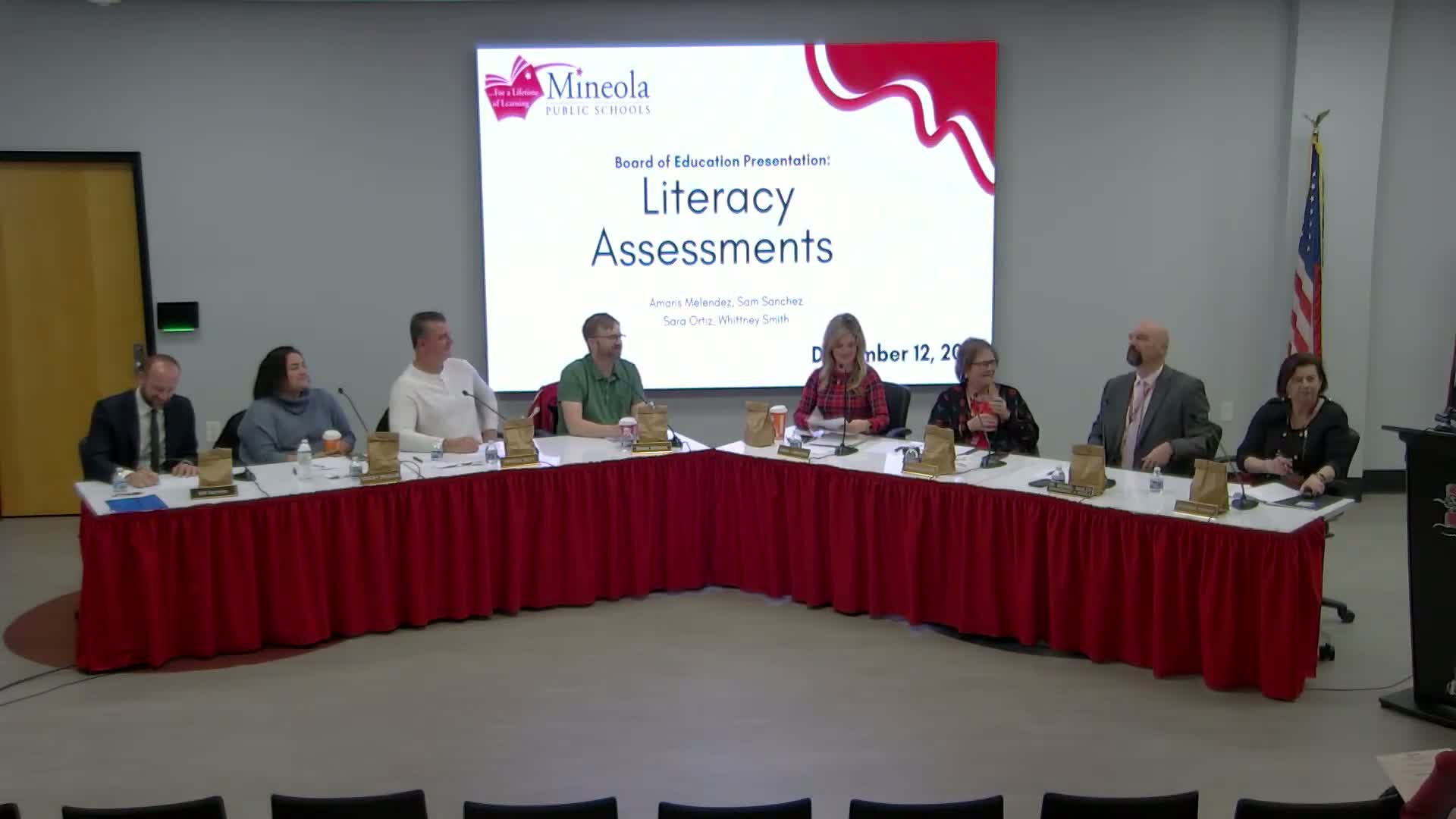
Summary
District instructional leaders presented their literacy-assessment framework—Scarborough's Rope—explained how NWEA, EasyCBM and Lexia inform tiered interventions and progress monitoring, and described limited pilots of AI-generated decodables as teacher tools, not replacements.
Amaris Melendez, a new instructional leader for the Mineola Union Free School District, told the school board that literacy assessments are used to "see what is thriving and what are those areas that need a little tender loving care" and to guide instruction.
The presentation, aligned to the board goal of building professional understanding of the science of reading, framed reading as the weaving together of multiple skill strands using Scarborough's Rope. Melendez explained that the district uses a mix of assessment types—"universal screeners, diagnostic, formative, summative"—to identify which skills are strong and which need targeted work.
Dr. Smith reviewed the district’s primary tools, saying NWEA is used as the universal screener and EasyCBM for benchmarking; the district also uses Lexia as an adaptive platform. "Lexia not only provides teachers with important data, but also provides targeted activities along with ways to celebrate student gains," Dr. Smith said, noting Lexia English supports entering and emerging language learners.
Staff explained how assessment data moves students into tiers of support. Sarah, a district instructional staffer, described the response-to-intervention structure: Tier 1 is classroom differentiation; Tier 2 is targeted small-group instruction; Tier 3 is intensive daily intervention with full-team meetings and family communication. She showed a progress-monitoring example in which a learner’s midyear goal was set at 68 and the student sat at 66, noting "slow and steady growth" after multiple progress checks.
The presentation listed interventions the district uses, from targeted Lexia lessons to intensive phonics programs such as SPIRE and brief diagnostic measures like Heggerty for phonemic awareness. Presenters emphasized that interventions are chosen based on student need rather than program marketing: "It's the needs of the learners. So we adjust the programs," one staff member said.
Board members asked about the growing role of artificial intelligence in education. A district presenter described AI as a tool that can quickly synthesize a learner's profile and suggest research‑based interventions: "What the AI is able to pop out in seconds is so valuable," the presenter said, while stressing that AI is meant to support teachers, not replace instruction. The district reported small pilots, including an AI-generated decodables program called LitLab and teacher-shared DATs (digital assistive tools) developed inside the community.
In question-and-answer exchanges, staff said apps are "pushed" by grade level to reduce 'app fatigue' and that the district uses an independent benchmark rather than vendor-provided benchmarks to avoid conflicts of interest. Leaders repeatedly returned to a theme that teaching and year-long instructional work, not a single summative test score, define student growth.
The presentation concluded with an offer to remain after the meeting to answer additional questions and to share dashboards and materials with board members.