
Bullitt County FRC/YSC coordinator reports $1.12 million allocation, outlines services and student supports
Get AI-powered insights, summaries, and transcripts
Sign Up Free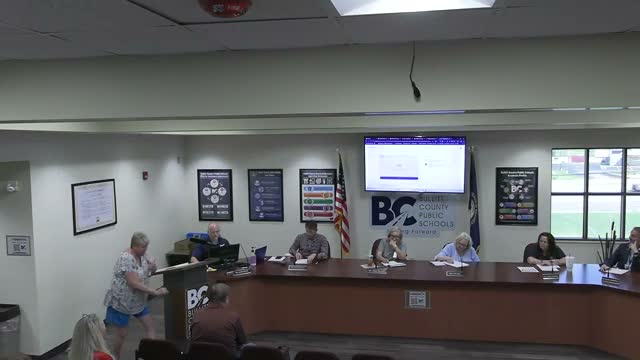
Summary
Family Resource & Youth Service Center coordinator Megan Hatter told the Bullitt County Board the program has 13 coordinators and six assistants, a $1,123,698.44 allocation for next year, and recent results including 300 vision screens (58 new glasses) and thousands of mental‑health contacts.
Megan Hatter, a Family Resource & Youth Service Center (FRC/YSC) coordinator, told the Bullitt County Board of Education at its May work session that the district’s FRC/YSC network has 13 coordinators and six assistants and has been allocated $1,123,698.44 for the coming year.
“The calculation is a max of 450 students, and a minimum of 180… This year it was $211.46 a child,” Hatter said, explaining how the program’s per‑child funding is determined. She said the program is written into law, citing “KRS 1564977,” and described FRC/YSCs’ mission to address nonacademic barriers to learning, not classroom instruction.
Hatter walked the board through services and outcomes the centers reported this year: Shepherdsville Elementary conducted vision screens for 300 students, which resulted in 58 students receiving new glasses; coordinators documented 8,313 suicide‑prevention contacts and 4,878 participants in mental‑health groups; and the district reported $712,000 in direct in‑kind support documented in its systems. Hatter said coordinators also manage contracted practitioners who meet with students, and that many centers have expanded partnerships to bring dental, vision and other services onsite after several contracted programs were discontinued.
Board members pressed staff on budget and program risks. A board member said legislators are supportive but warned that proposed state budget language could affect the program’s funding, and Hatter flagged a recent change to Medicaid coding that reduced direct certification and affected funding calculations.
Hatter described several ongoing and planned activities: biannual grant applications and needs assessments guided by advisory councils, career‑exploration trips, Safe Sitter certification for middle‑school students, bilingual instructional assistants and partnerships with local agencies to help families secure child care. She said advisory councils meet regularly and play a central role in hiring and evaluation of coordinators.
Hatter closed by saying coordinators submit quarterly reports so the board can track services and by inviting questions and connections to the centers.
The district did not provide a detailed line‑item breakdown of the $1.12 million allocation during the presentation; Hatter said some figures (for example, the $712,000 described as in‑kind donations) do not include additional grants and are focused on commodities and donated goods.