Get Full Government Meeting Transcripts, Videos, & Alerts Forever!
Get email alerts on the Federal Policy topic
No spam. Unsubscribe anytime.
Outside counsel briefs Arapahoe County on congressional reconciliation, rescissions and local program risks
Summary
County counsel and outside lobbyists updated commissioners on the congressional reconciliation timeline, potential Medicaid and SNAP changes, rescissions proposals, and risks to programs the county relies on (CDBG, SRFs); they urged constituent outreach and fact sheets to county delegation.
Arapahoe County commissioners received a federal policy briefing from outside counsel and state lobbyists covering the status of congressional reconciliation, likely rescission activity, and plausible impacts on federal programs the county uses.
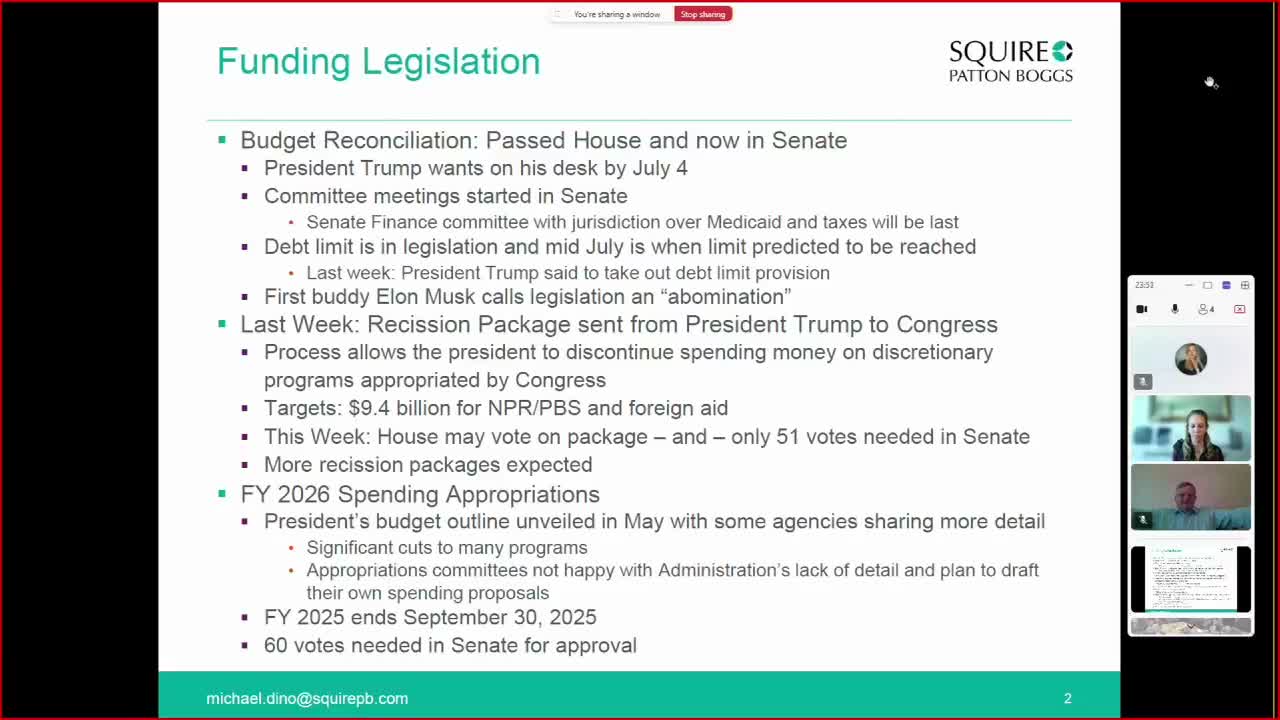
Presenters from Patton Boggs summarized that reconciliation work was moving quickly in Congress and that the House and Senate versions could differ; they flagged provisions that may reduce federal funding or alter program rules (Medicaid work requirements and SNAP penalty provisions among them) and highlighted that some appropriations and formula programs the county leverages—Community Development Block Grants (CDBG), state revolving funds (SRFs) for water and wastewater, and other discretionary grants—could face reductions or policy changes in FY2026 appropriations and reconciliation outcomes.
Presenters also noted a rescissions package expected in the near term that would target roughly $9.4 billion and include items such as public broadcasting funding and foreign aid. Counsel suggested local advocacy steps: generate concise fact sheets describing local use of federal programs, communicate direct impacts to the county delegation, and prepare constituent letters explaining how specific cuts would affect Arapahoe County residents.
Local context: presenters said some county projects previously included in federal spending cycles were left unfunded after continuing resolutions in FY2025; they recommended renewed outreach to congressional offices and provided examples of recent committee movement on relevant provisions. Commissioners discussed the political dynamics around reconciliation, potential court challenges, and the administrative cost of implementing any new program requirements (for example, work‑requirement tracking under Medicaid would create large administrative burdens for counties and the state). Commissioners asked for follow‑up materials and for staff to coordinate with outside counsel where federal funding is at risk.
Next steps: outside counsel and county staff will prepare fact sheets on affected programs, track appropriations committee activity and notify the board about opportunities to contact the delegation or prepare local testimony.