Get Full Government Meeting Transcripts, Videos, & Alerts Forever!
Get email alerts on the Public Health Cha topic
No spam. Unsubscribe anytime.
DDPHE releases Community Health Assessment: 90,000 uninsured, housing and racism named priorities
Summary
Denver's Department of Public Health & Environment presented a published Community Health Assessment that identifies three priorities for the next five-year Community Health Improvement Plan: access to health care (about 90,000 uninsured), safe and affordable housing (37% cost-burdened), and systemic racism with marked life-expectancy disparities.
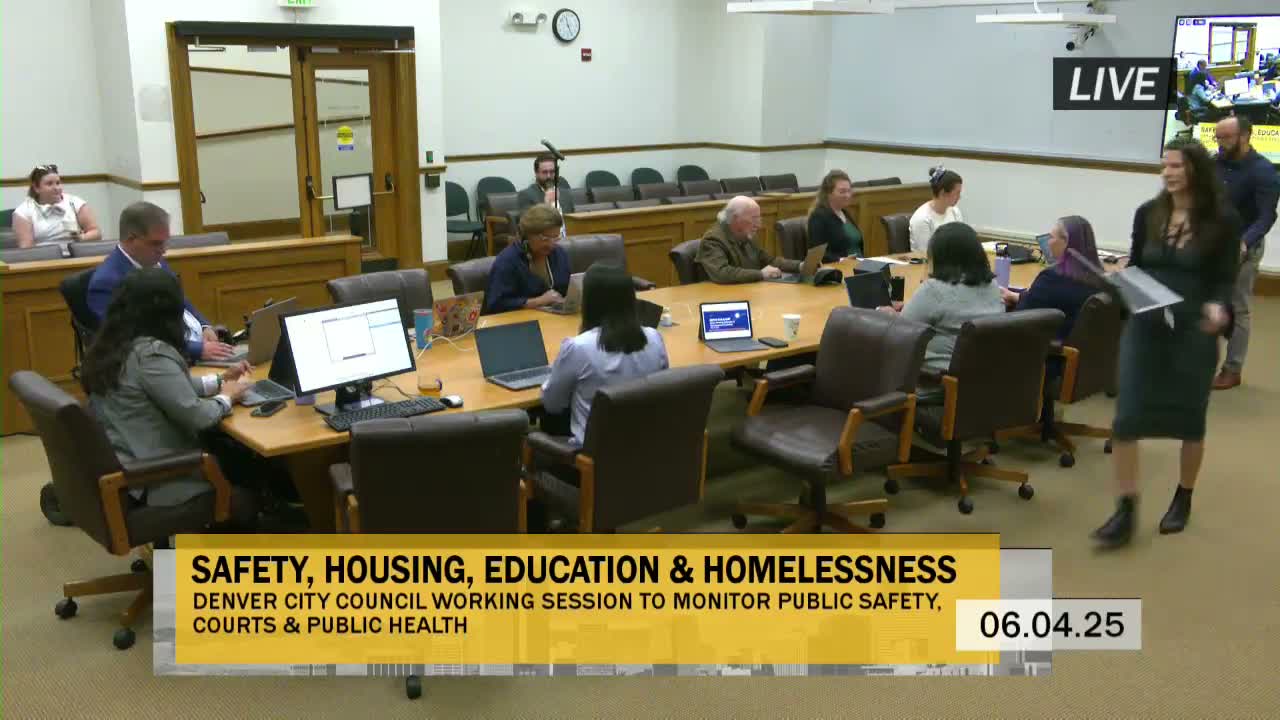
Nathan Keffer, community assessment and improvement planning senior analyst at the Denver Department of Public Health & Environment (DDPHE), told the council on June 4 that the CHA is published as an interactive story map and is the basis for a five-year Community Health Improvement Plan (CHIP).
DDPHE said the CHA involved extensive community engagement: dozens of partner organizations, 12 focus groups, two town halls (with a third planned in Westwood in Spanish), and a survey of more than 2,000 Denver residents. "We heard from over 2,000 folks in our community health assessment survey," Keffer said, describing the breadth of input used to identify priorities.
Agnes Marcos, lead data analyst at DDPHE, summarized three priorities chosen by community partners and residents: access to health care (including mental and behavioral health), safe and affordable housing, and systemic racism. Marcos told the committee that DDPHE found roughly 90,000 uninsured people in Denver and that 11 of 12 focus groups reported problems accessing care.
On housing, DDPHE reported that 37% of Denver households are housing cost burdened (paying at least 30% of income on housing) and that cost burdens cluster in neighborhoods with higher shares of people of color, people in poverty and limited-English-proficiency residents. The presentation included maps and focus-group word clouds to illustrate geographic and demographic concentration of needs.
DDPHE also presented life-expectancy disparities by race and ethnicity: staff said the average newborn life expectancy for Denver overall was about 78 years, with the highest subgroup just over 84 years and substantially lower life expectancy shown for certain populations (examples cited included 46.8 years and 62.6 years for specific demographic groups), which staff characterized as evidence of systemic racism affecting health outcomes.
Keffer and colleagues said the CHA is a starting point: DDPHE is recruiting CHIP working groups (one per priority) that will mix city staff, health-care partners and community members to set measurable goals, strategies and objectives. DDPHE plans to publish the CHIP by the end of the calendar year and noted that implementing the plan will likely require budgetary requests and cross-agency collaboration.
Council members asked for more targeted breakdowns (age groups, neighborhood-level nuance), plans for recruitment to the working groups, and concrete, low-cost actions that the council could pursue during budget constraints. DDPHE said the CHA is the data phase and that the CHIP will specify implementation steps and measurable goals.
What happens next: DDPHE will recruit working-group participants, continue public engagement (including a Spanish-language town hall), publish the CHIP by year-end and return to council with status updates during implementation.