Get Full Government Meeting Transcripts, Videos, & Alerts Forever!
Get email alerts on the Criminal Justice Family Violence topic
No spam. Unsubscribe anytime.
Denver DA details split of family-violence work, highlights firearm-relief investigations
Summary
Denver District Attorney's Office told the City Council's Safety, Housing, Education, and Homelessness Committee that it has split its Family Violence Unit into specialized child-victim and domestic-violence teams, is managing about 600 active cases across 11 attorneys, and reported nearly 200 investigations and 165 firearms relinquished in the past year under recent statutes.
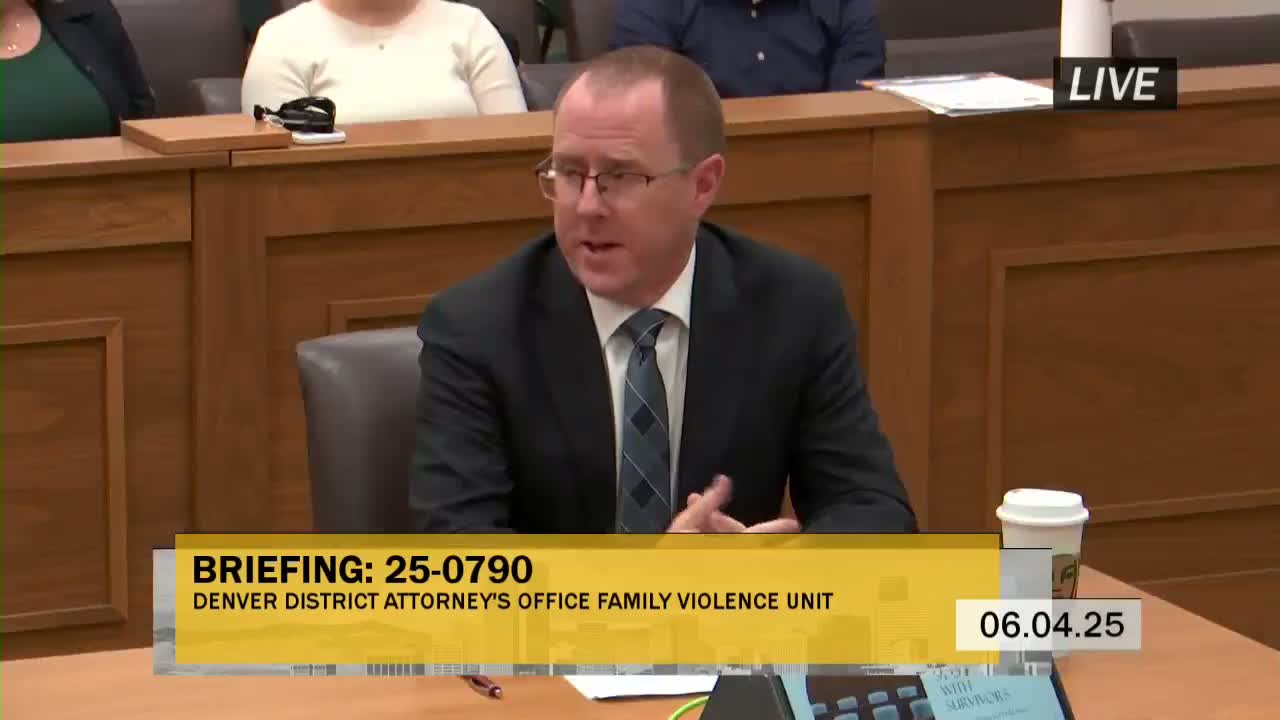
Chris Curtis, chief of the child-victim unit at the Denver District Attorney's Office, told the City Council's Safety, Housing, Education, and Homelessness Committee on June 4 that the office has restructured its Family Violence Unit to create dedicated teams focused on child abuse and on domestic violence.
"We titled this presentation standing with survivors," Curtis said, framing the change as part of a victim-centered approach. He said the office's team includes investigators, investigator-technicians, legal administrative staff and victim advocates who work in courtrooms and with partner agencies to support victims and build cases.
Danny Worley, the DA's child-abuse specialist, described Denver's pre-filing process and the role of embedded specialists who work with detectives, forensic interviewers and the Denver Children's Advocacy Center to improve consistency in charging and trial preparation. "That collaboration is really a critical piece," Worley said, describing daily multidisciplinary check-ins at the Denver Safe Center.
Curtis and Worley said the unit handles serious caseloads: "At any given moment in time, the family violence unit across our 11 attorneys is handling about 600 cases," the presenters said. They told council members that the reorganization, which the DA's office implemented the week before, is intended to concentrate expertise and improve outcomes, but that resource limits remain a significant constraint.
On the domestic-violence side, the office described a firearm-relinquishment program administered by a dedicated domestic-violence specialist and investigator. "Just in the past year ... there have been almost 200 open investigations under this act and the relinquishment of 165 firearms," Curtis said, noting those firearms were accessible to people accused of domestic violence.
Council members questioned how often victims decline to cooperate and whether the office can pursue cases without victim testimony. The DA team replied that recantation is common and that filing decisions are made with the possibility of noncooperation in mind; where physical or corroborating evidence exists, prosecutors said they can sometimes proceed without the victim on the stand.
Council members also pressed for more data on whether relinquishment has reduced harms and for longitudinal information on children who later enter juvenile or adult justice systems. The DA's office said it did not have all of the requested quantitative follow-ups available at the briefing and offered to provide additional data to council offices.
The presentation emphasized trauma-informed courtroom practices, the use of experts to explain recantation, and the need for increased staffing and co-location of partner services to reduce workload and improve victim outcomes. The committee scheduled follow-up opportunities as requested by council members.
What happens next: DA staff offered to follow up with the committee on requested data (relinquishment outcomes, comparative jurisdictional data and withdrawn/declined-testimony rates). The presenters said additional staffing and co-location of partner agencies are among the priorities to improve case outcomes.