Get Full Government Meeting Transcripts, Videos, & Alerts Forever!
Get email alerts on the Climate Programs topic
No spam. Unsubscribe anytime.
Council committee briefed on $23.5 million Climate Protection Fund program-administration contract
Summary
The Business, Arts, Workforce, Climate, and Aviation Services Committee heard a presentation on a proposed three-year, $23.5 million contract to consolidate administration of Climate Protection Fund rebate and grant programs; the fee is a maximum 7% (6% base + up to 1% performance) with roughly $21.8M earmarked for recipients, officials said.
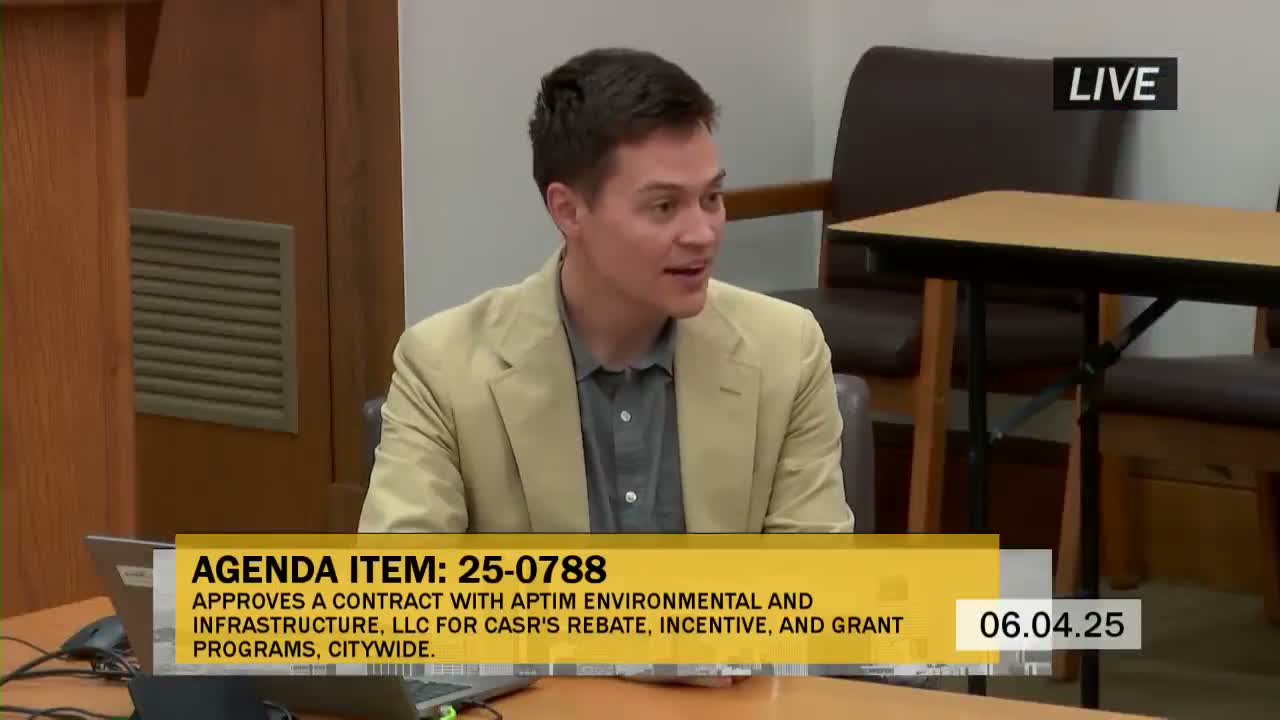
Jonathan Rogers, acting deputy executive director for Denver’s Office of Climate Action, presented a proposed three-year contract to serve as the consolidated administrator for multiple rebate and grant programs funded through the city’s Climate Protection Fund ordinance. Rogers said the contract’s maximum value is $23,500,000; the administrator would receive a fee equal to a maximum 7 percent of rebates distributed (a 6 percent base fee plus up to 1 percent available as a performance incentive), and the remaining funds—about $21,800,000—would be available for distribution to recipients in the Denver community.
Rogers told the committee the contract will centralize intake, streamline approval and payment processes, and consolidate program data to support impact evaluation. He cited the vendor’s prior work running Denver’s e-bike voucher program and described faster reimbursements and improved customer support as key benefits. "We've had nearly 10,000 e-bike vouchers distributed," Rogers said, and the vendor’s software enabled reimbursements within 24–48 hours in many cases, he added.
Committee members asked detailed questions about procurement, equity protections, residency verification, and the contract’s impact on city staffing. Rogers said the vendor was selected via a competitive solicitation and was one of several firms evaluated for software capability, longevity and market rates. On equity, he said program design prioritizes income-qualified households, disproportionately impacted census tracts and equity-priority organizations such as affordable housing providers, food pantries and clinics, and that the administrator can support additional outreach or engagement services through subcontractors when needed.
On e-bike residency verification, Sue Baldwin, who runs the e-bike program, said applicants must provide proof of income and residency—typically a driver's license or a utility bill within the last month—and staff verify each document before issuing a voucher. Rogers and Baldwin said the program limits vouchers to one per person and conducts voluntary, post-redemption surveys to gather usage and outcome information, though they acknowledged follow-up cannot guarantee a voucher was not later resold.
Councilors also pressed on fee mechanics and whether the contract would displace city jobs. Rogers said the 6 percent is a base administrative fee and the extra 1 percent is performance-based; he described the contractor as providing software and staffing support equivalent to several full-time employees and said the arrangement is intended to relieve administrative burden rather than eliminate city positions. Rogers said exact dollar savings to the city had not been calculated but that the consolidated mechanism should free staff to focus on program design and impact evaluation.
Rogers emphasized that all disbursements remain subject to annual appropriation and that the contract does not guarantee payment if the council does not allocate funds in future budgets. He offered to share available demographic and geographic participation data with council members who requested it. The committee proceeded to request a motion on the action item, but a roll-call result or final vote tally does not appear in the supplied transcript segments.