Get Full Government Meeting Transcripts, Videos, & Alerts Forever!
Get email alerts on the Neglected Derelict Buildings Ordinance topic
No spam. Unsubscribe anytime.
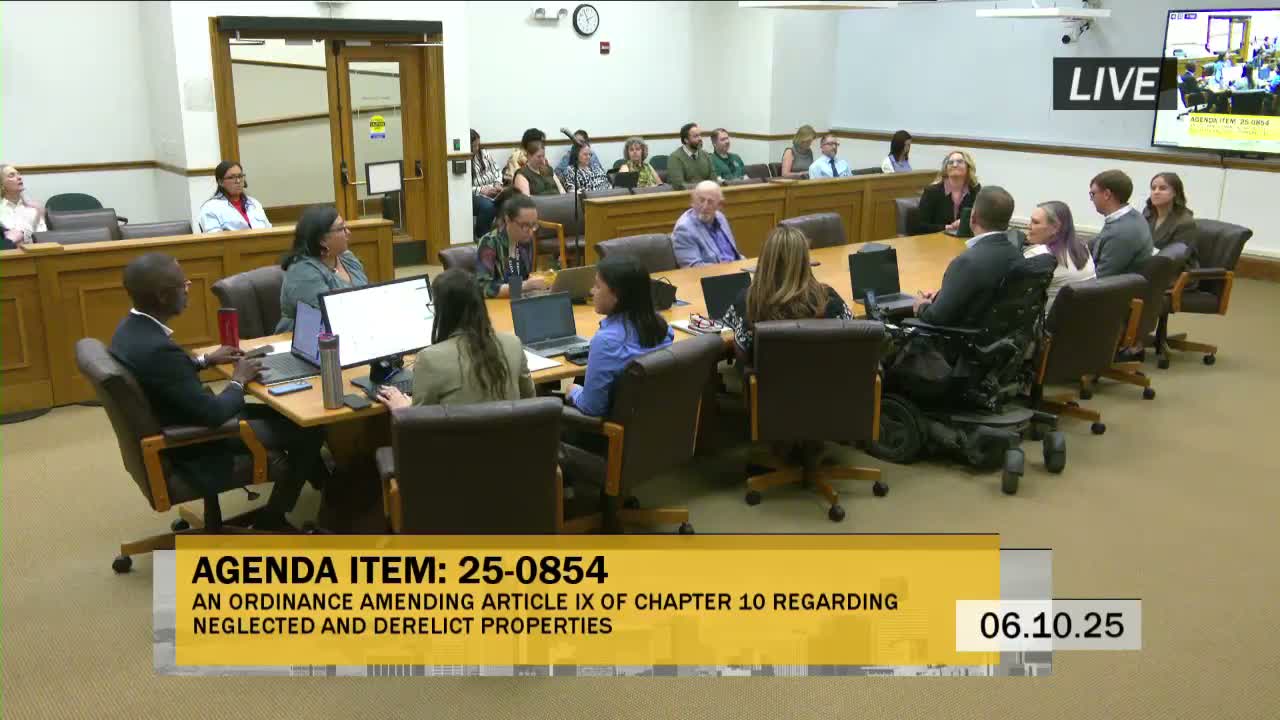
Committee forwards overhaul of neglected and derelict buildings ordinance, raising fines and adding remedial-plan process
Summary
The committee voted to forward proposed changes to Denver's neglected and derelict buildings ordinance that would create an early remedial-plan assessment meeting, expand criteria to vacant land and historic properties, and raise administrative fines up to $5,000. Presenters said implementation timing will be flexible because of budget constraints.
The Land Use, Transportation and Infrastructure Committee on June 10 voted to forward a package of changes to Denver's neglected and derelict buildings ordinance to the full City Council.
Sponsors and city staff described a package that creates an early remedial-plan assessment meeting, clarifies appeals paths, increases enforcement tools and explicitly includes vacant lots in the definition of neglected and derelict property. A CPD presenter said planning staff received letters of support from neighborhood organizations and that the planning board and task force work informed the legislative language.
Under the proposal, property owners would meet with Community Planning and Development within 60 days after an initial order to develop a remedial plan; if CPD issues a remedial plan the owner could appeal. The ordinance would also allow administrative citations for violations, with language in the draft allowing fines and citations up to $5,000 (an increase from the current $999-per-day ceiling in the existing code). Presenters said unpaid penalties could result in liens, criminal prosecution or receivership.
The proposal adds vacant land to the ordinance's scope so properties without structures but that present hazards (for example after demolition) can be designated neglected and derelict. Historic properties would receive additional process protections: CPD must notify the Landmark Preservation Commission prior to certain emergency abatements and the ordinance language includes ways to coordinate preservation review.
City staff also proposed a new annual reporting requirement: CPD would report to City Council by March 31 each year on penalties and enforcement data to inform budget discussions. Presenters acknowledged a projected $200 million to $250 million city budget shortfall and urged flexibility in the ordinance effective date; staff estimated adopting the ordinance could produce roughly a 30% increase in administrative citations and a need for additional tracking and staff resources.
Several residents and neighborhood representatives spoke in support during public comment, describing safety problems and property neglect. Hillary Cortel, executive director of the Colfax business improvement district, said neglected properties "pose a number of problems" including "open drug use, prostitution, fires" that suppress nearby economic activity. Shay Scott, manager of zoning and neighborhood inspections for CPD, explained the 48-hour notification language refers to placarding and mailed notice and said staff upgraded Acela tracking to improve enforcement and citation workflows.
After committee discussion and questions about operationalizing notice and appeals, the chair called for a motion and committee members signaled approval to forward the ordinance to the full council for consideration.
The ordinance is scheduled to move through mayor/council first-reading and subsequent council readings per the sponsors' timeline; staff said they will work with the Department of Finance and the Mayor's Office to refine an effective date if additional time is needed for implementation.