Get Full Government Meeting Transcripts, Videos, & Alerts Forever!
Get email alerts on the Costs Contingency topic
No spam. Unsubscribe anytime.
Council members press DOF on cost estimates, 10% contingency and pricing accuracy for Vibrant Denver
Summary
Councilmembers raised multiple concerns that project cost estimates provided to the executive committee appear inflated in some cases and sought clarity on the proposed 10% contingency (noting the charter requires 2%); DOF defended the market-average contingency and described monitoring and project-level contingencies.
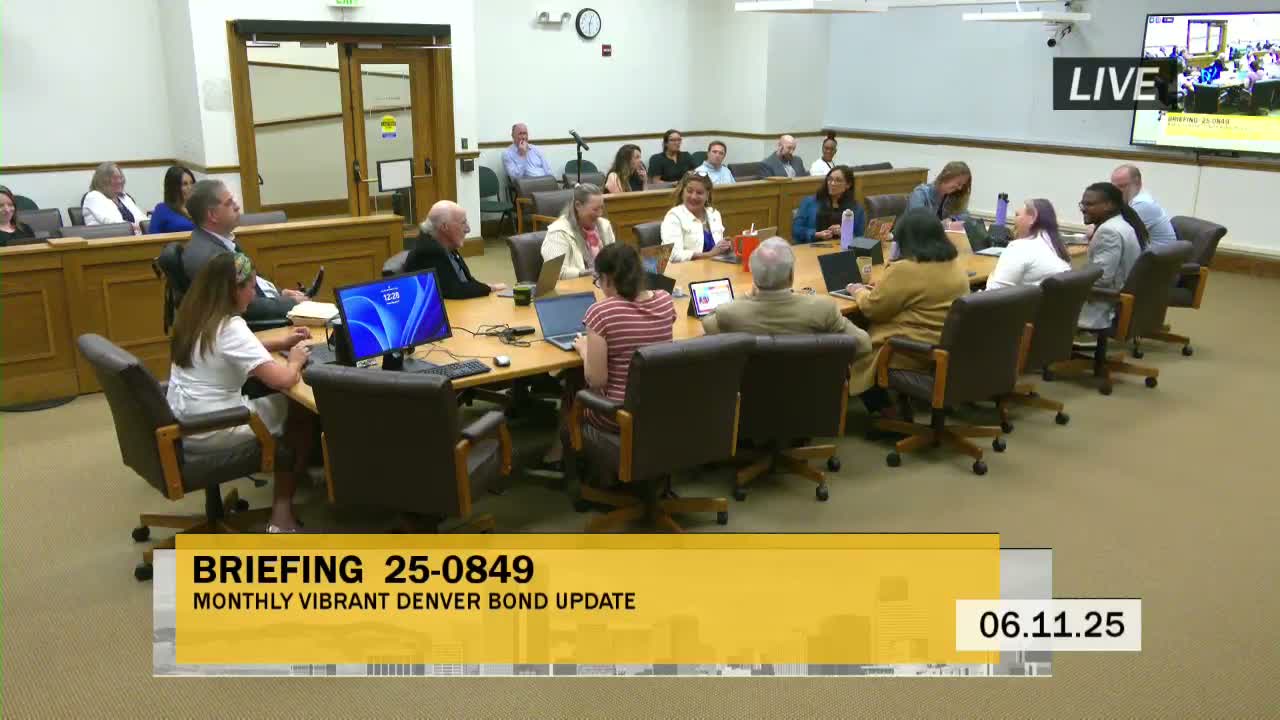
Council members in Denver's Geo Bond Working Group questioned Department of Finance staff Wednesday about project cost estimates and the bond's contingency approach, providing several specific examples they said show the executive committee is working with inflated pricing.
Councilwoman Vida Sawyer asked DOF to provide exact ballot and companion ordinance language before committee review and to list which projects are included in the citywide programs. She also raised concerns about contingency calculations, asking whether the proposed 10% is in addition to the charter-required 2%. DOF replied that the 2% is included in the 10% ("it is encompassing of the 2%"), and that project-level contingencies already exist in individual project cost estimates as well as the package-level holdback.
Sawyer offered a specific example she said is documented: a set of quick-win traffic implementations her office estimated at roughly $775,000, which the executive committee had listed as $10,500,000. "The dollar amount that the executive committee is considering is $10,500,000. That is 900% over the actual cost of the project and that is insane," Sawyer said, pressing staff on how the executive committee received such a discrepancy. DOF acknowledged the concern, said staff are using market-average figures while projects remain undefined and recommended stronger monitoring and reporting so large contingencies are not left unspent or lead to mid-program cuts.
Other council members voiced related worries. Councilmember Jamie Torres asked whether projects can be partially funded or scaled to better fit district priorities and said bundling sometimes diluted neighborhood-driven priorities. Councilmember Hines cited a deferred-maintenance estimate from the Jacobs report of just under $7,000,000,000 and questioned whether an $800,000,000 bond could make meaningful progress on urgent end-of-life infrastructure needs.
DOF said they have worked to flag reinvestment projects across the list and to include condition assessments and CIP status in project descriptions; staff offered one-on-one briefings and said they will bring as much detail as possible to a July 9 informational briefing and to individual council briefings prior to committee.
No formal motion or vote was taken; councilmembers asked staff to supply written examples, the draft ballot text and companion ordinance language and to review project-level costing before committee consideration.