Get Full Government Meeting Transcripts, Videos, & Alerts Forever!
Get email alerts on the Shelter Contracts topic
No spam. Unsubscribe anytime.
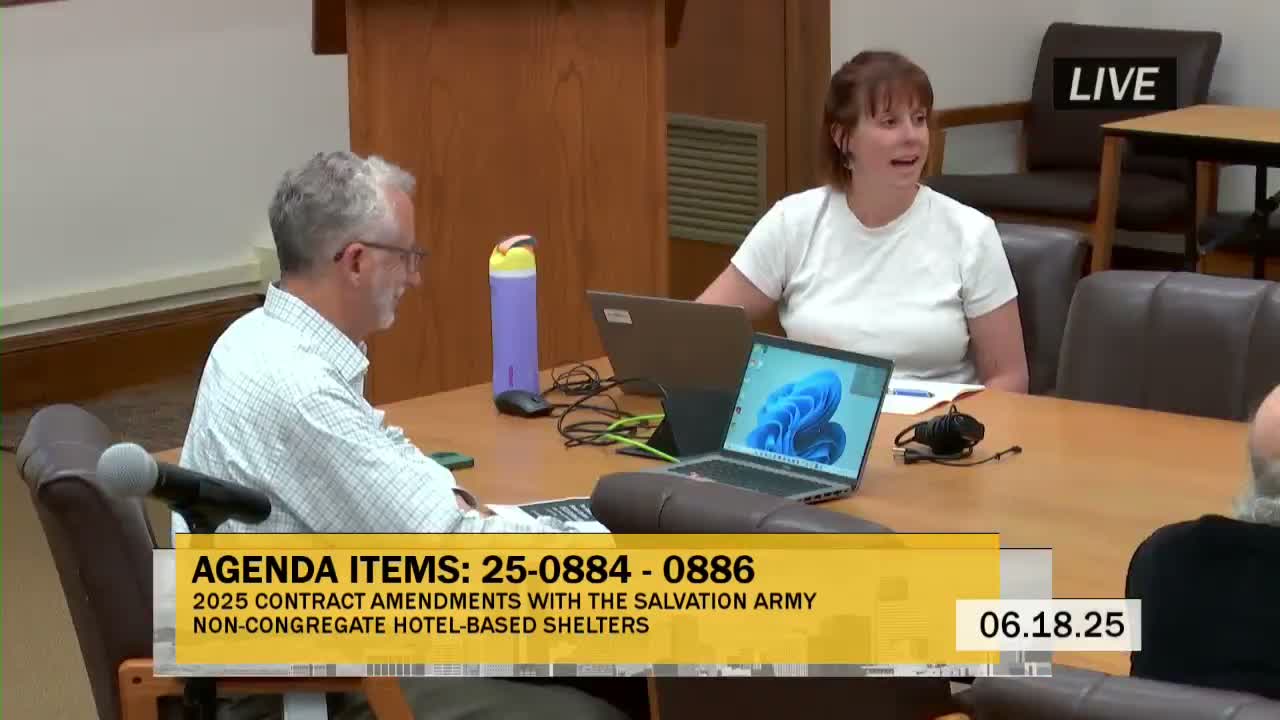
Council committee advances three Salvation Army shelter contract amendments to full council
Summary
The Safety, Housing, Education and Homelessness Committee voted to forward three contract amendments with The Salvation Army — Aspen, Stone Creek and Tamarack — to the full Denver City Council, while pressing HOST on retroactive payments, staffing, incident reporting and procurement timelines.
The Safety, Housing, Education and Homelessness Committee on June 18 voted to move three contract amendments with The Salvation Army forward to the full Denver City Council.
HOST (Housing Opportunity and Stability Team) asked the committee to approve: a $7,000,000 amendment for the Aspen (DoubleTree) site, a $4,200,000 contract for Stone Creek, and an approximately $8,000,000 amendment for the Tamarack family shelter. HOST staff said the amendments extend contracts through December 2025 and cover operations including 24/7 guest services, meals, laundry, case management and security provided under a separate city contract with Securitas.
Committee members pressed HOST and Salvation Army representatives on several operational and fiscal details. Councilmember Amanda Sawyer criticized the timing of the requests and the need to pay providers retroactively: “We have to pay the Salvation Army for services that they have already provided to us,” she said, adding that retroactive approvals limit the council’s ability to insist on programmatic changes.
HOST said they recognize the problem and will provide a memo laying out improvements and a schedule for future contracting. STAFF described a move to regularized multiyear contracts: HOST plans to issue RFPs on a three‑year cycle beginning in 2026, with an interim batch approach so council sees related shelter contracts together. HOST told members there are two additional Salvation Army contracts expected to be processed retroactively (one linked to rapid rehousing).
On site performance, HOST shared outcome and cost figures drawn from HMIS and contractors’ reports. HOST said Aspen (roughly 289 units) serves about 750 households a year at about $49.43 per guest per night, reporting a 62.6% positive exit rate and that The Salvation Army reported contributing about $2.1 million in additional resources. Stone Creek (about 182 units) runs at just under $60 per person per night, with host reporting a 71% positive exit rate and Salvation Army investment of roughly $979,000. The Tamarack family shelter (about 205 units) was described as costing about $93 per family per night, serving roughly 600 shelter guest families and about 1,000 families through access and intake services, with an approximate 75.6% positive exit rate.
Councilmembers also asked about staffing and vacancy rates. HOST said Aspen has 67 authorized staff with 57 positions filled (about a 14.9% vacancy rate); Stone Creek had a higher vacancy rate (~24%); Tamarack’s vacancy rate was about 12%. HOST explained the contracts are cost‑reimbursement arrangements and providers are only paid for filled positions; payroll records are submitted with invoices.
Tyler Burwell, interim director for Denver Metro Social Services at The Salvation Army, told the committee the nonprofit had paid for some client supports and administrative costs not covered by the city, and that the organization had invested significant sums across its programs. On incident reporting, HOST said it receives critical incident reports (for serious violence, fire, overdoses and similar events) in near real time and can notify council offices; Salvation Army said it also can communicate directly to councilmembers on request.
The committee moved the three contract items as a block (moved by Councilmember Amanda Sawyer; seconded by Councilmember Jamie Torres) and voted to forward them to full council without a roll‑call vote. The committee did not make final funding determinations; full council will consider final approval.
Next steps: HOST will circulate a contracting memo and schedule to council, and the RFP process for replacement/longer‑term contracts is expected to continue through 2026.