
Work group debates payment, labeling and real-time availability rules for public EV chargers
Get AI-powered insights, summaries, and transcripts
Subscribe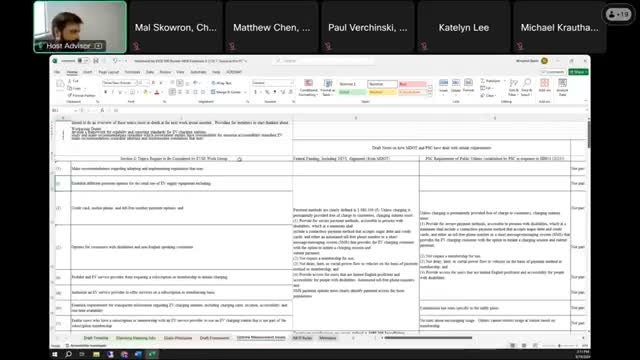
Summary
Members debated requiring contactless payment and clear labeling for public chargers, consumer disclosures of price-per-kWh, and near-real-time availability reporting; industry cautioned about cost impacts for level-2 chargers and recommended phased rules.
Maryland regulators and industry representatives debated rules for payment methods, transparent pricing and real-time availability for public EV charging stations, weighing consumer protections against deployment costs and emerging vehicle-based payment technologies.
Ben (moderator) reminded members that the NEVI program and earlier Public Service Commission guidance require multiple payment options, and that customers must see the unit price before initiating a transaction. Allison (Weights & Measures) explained that Maryland law requires the customer to know the unit display price (dollars per kilowatt hour) and any additional fees upfront; she compared the correct method of sale to other metered goods regulated under Handbook 44.
Members asked whether to require contactless credit-card readers for public-facing chargers. Josh (SWTCH) and Michael (ATE) warned that credit-card readers are relatively expensive for level-2 hardware and could raise deployment costs; Michael noted that ISO 15118 vehicle-based credentialing is emerging and could soon serve as an alternate payment credential. "It would be unfortunate to implement a regulation that requires the industry to spend a lot of money deploying credit card readers when in, you know, two years, the use of those readers may decline precipitously," Michael said.
Industry and agency speakers supported transparency and consumer protections. Amanda (MDOT) said NEVI-funded contractors include compliance plans in RFPs and that labeling and customer-service commitments are enforced contractually for MDOT projects. Paul (participant) recounted an example at BWI Airport where a station appeared available in apps but was throttled by the utility, leaving drivers with longer charging times; members argued that such conditions should be disclosed in real time to avoid stranding motorists.
Panelists discussed practical distinctions: DC fast chargers generally accept credit cards on-site, while many level-2 chargers do not. Members suggested a tiered approach—requiring contactless/toll-free options for public-facing DC fast chargers and planning phased standards for level-2 units—and recommended that labeling include unit price per kWh, any additional fees, and customer-service contact information.
Ending: No regulatory decisions were finalized; staff will incorporate these payment and transparency considerations into the circulating framework and seek member feedback.