Get Full Government Meeting Transcripts, Videos, & Alerts Forever!
Get email alerts on the Framework Scope topic
No spam. Unsubscribe anytime.
Maryland work group debates scope of proposed EV charging rules: commercial, utility and MUD sites in focus
Summary
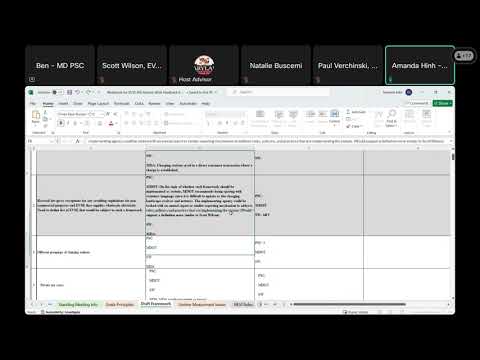
A PSC‑led work group hashed out competing definitions of which electric vehicle charging stations should be regulated, with members split between limiting rules to commercial operators and a broader approach that would capture utility‑owned, multi‑unit dwelling and semi‑public chargers.
Ben Baker, convening the Maryland Public Service Commission’s electric vehicle work group, opened the meeting by asking members to agree on a draft framework the group could refine and hand to agencies for budget planning. “We really do need to have what I would call a serious draft framework,” Baker said, setting the meeting’s principal goal.
Why it matters: the choice of who is subject to regulation determines enforcement lines, reporting obligations, and the number of sites that state agencies would need to monitor and inspect.
The group described two main approaches. One narrow approach would regulate charging stations used for commercial purposes — locations that charge a fee or otherwise operate in commerce. A broader approach, supported by several participants and reflected in MDOT’s updated recommendation, would treat utility‑owned chargers, workplace chargers and many multi‑unit dwelling (MUD) installations as “semi‑public” and bring them within the regulatory framework even where they are not operated as traditional businesses. Amanda Heiner of MDOT urged inclusion of utility‑ and state‑owned stations and said some workplace and MUD chargers should be considered semi‑public and subject to the rules.
Industry and advocacy voices warned about grey areas. Members noted that private fleet chargers, trucking company networks and HOA‑owned chargers can fall into ambiguous categories: they are not strictly household chargers but are also not conventional public stations. Paul Boginski and Scott Wilson flagged that the framework could include calibrated levels of oversight so that, for example, an HOA amenity is treated differently than a public DC fast charging site.
“Different levels of response for different categories of chargers” was a recurring theme: the group repeatedly returned to a tiered approach that treats DC fast chargers, which are costly and typically operated by large network providers, differently than lower‑cost level‑2 chargers that landlords or small property owners install as amenities.
Next steps: the chair said he would circulate a written summary of the group’s emerging definition and asked members to review and provide refinements ahead of the next meeting, when industry participants will present models from other states.
Ending: The work group did not adopt a final definition; it agreed to circulate a strawman for comment and revisit the eligibility question with additional industry input at the next session.