
Maryland work group recommends separating charger reliability reporting from meter accuracy, urges incremental approach
Get AI-powered insights, summaries, and transcripts
Subscribe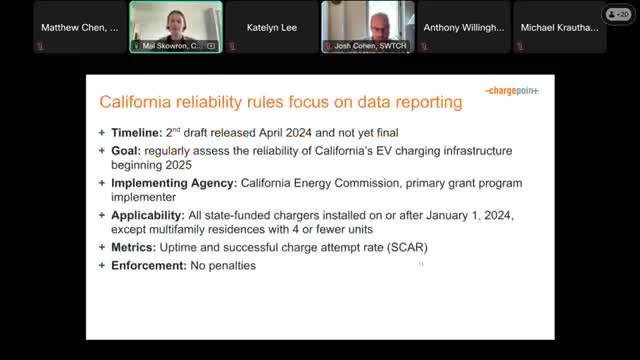
Summary
A Maryland work group discussed aligning reliability data reporting with NEVI and California models while leaving meter accuracy to weights-and-measures enforcement; members cautioned against heavy-handed penalties for older chargers and recommended staged implementation and grandfathering for existing equipment.
A Maryland Public Service Commission work group on electric vehicle charging agreed that uptime reliability reporting and meter accuracy should be treated as separate regulatory tracks, and several members urged an incremental approach that aligns with existing federal and state programs.
Ben (moderator) opened the meeting by circulating a straw-man framework and asked the group to decide whether to separate 'uptime reliability' responsibilities from meter-accuracy duties already handled by the Maryland Department of Agriculture (MDA). Mal (ChargePoint) summarized California’s draft Energy Commission rules, which would require reliability reporting for publicly funded chargers placed in service after Jan. 1, 2024, with the first statewide report due in 2025. Mal said the California draft focuses on network operator reporting and, at present, does not include explicit penalties for failing to meet draft uptime metrics.
Michael Krauthammer of the Alliance for Transportation Electrification (ATE) recommended a cautious, stepwise policymaking approach. "We recommend an incremental and light touch approach," he said, noting the work group must prepare recommendations for the general assembly by November. Michael also warned that some states’ efforts emphasize taxation rather than reliability, which the group should avoid replicating.
Members flagged several implementation concerns. Mal and industry speakers described administrative problems seen in California, including devices being 'tagged' (i.e., taken out of service) for registration or paperwork failures rather than because of metering inaccuracy, and the high cost and limited availability of specialized test equipment and registered service agents. "Tagging has mostly been related to process or administrative failures, not necessarily failures of station accuracy," Mal said.
Speakers recommended grandfathering existing, functional chargers to avoid removing working equipment. Michael pointed to Oklahoma’s long grandfathering period as an example; the group discussed possible ramp periods to give operators time to comply without disrupting service. Amanda (MDOT) confirmed that federally funded projects under NEVI already include NEVI-aligned requirements in RFPs and contracts.
The work group also debated the target uptime metric. Ben noted the commission and NEVI have adopted similar uptime requirements and flagged a proposed 97% uptime standard for discussion, asking who it would apply to and how to measure it (port vs. connector). The group discussed practical measurement issues: NEVI measures at the port level (one working connector suffices for the port), while the commission has at times measured to the connector level for enforcement.
Members emphasized the difference between assessing metrological accuracy (MDA/Handbook 44) and network or operational reliability (reporting and proactive monitoring). Allison (Weights & Measures) described the MDA role in registering agencies and licensing technicians and said meter sales and transactions must show unit prices and transaction terms up front.
The meeting closed with agreement to circulate a revised draft framework for member feedback and to continue refining recommendations—particularly on scope, enforcement tiers, grandfathering timelines, and whether to recommend statutory clarifications for uptime reporting. The group set its next meeting for Sept. 3 from 1–3 p.m.
Ending: The work group did not adopt final recommendations during the meeting; members tasked staff to circulate a revised draft framework and requested further input on priorities and implementation details before the next meeting.