Get Full Government Meeting Transcripts, Videos, & Alerts Forever!
Get email alerts on the Ev Charging Reporting topic
No spam. Unsubscribe anytime.
Work group favors reporting-first approach, public transparency and a single implementing agency for EV charger uptime
Summary
A multi-agency work group signaled support for a reporting-first framework (option 2) for public EV charging stations, aims for public uptime transparency and recommended MDA Weights and Measures as the likely implementing agency with PSC/MDOT as alternates. Agencies outlined a 12–18 month rollout with a one-year grace period before enforcement.
Members of a state electric vehicle charging reliability work group on Dec. 5 signaled broad support for a reporting-first regulatory approach that would require publicly accessible chargers to provide uptime and related data, while giving the implementing agency authority to escalate to stricter enforcement if reliability does not improve.
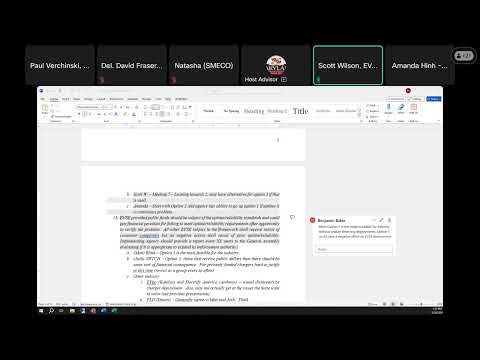
The group’s discussion centered on a three-tier framework. Under the preferred approach — labeled Option 2 in internal materials — the implementing agency would collect standardized uptime metrics and publish annual summaries; lawmakers or the agency could later move to Option 1 (stricter requirements) if persistent problems emerged. MDOT said it would support Option 2 with the ability to “step up to option 1” if ongoing reliability problems are documented in periodic reports to the General Assembly.
Why it matters: speakers emphasized the consumer harm when chargers are unavailable. "If you're open to the public in any way whatsoever ... then just like gas pumps have to be, monitored," Delegate Fraser Hidalgo said, arguing for public reporting and penalties when stations fail to return to service in a reasonable time.
Industry and network operators urged caution in how reporting is implemented. Matt of Blink and Emily from ChargePoint said reporting should protect proprietary information and consumer privacy; Michael Krauthammer of the Alliance for Transportation Electrification warned that broad mandatory reporting for privately funded chargers could discourage voluntary investment unless public funds or contractual strings justify it.
The group also discussed where responsibility should lie if a site’s charger is broken. Several members, including Paul Verchunski, argued that the entity shown as the site owner or the party that markets/operates the station should be the primary contact for enforcement and consumer outreach, but participants acknowledged many mixed business models (owner-hosted, network operator, subscription models) that complicate a one-size-fits-all rule.
On implementation timing, agencies proposed a staged rollout: the implementing agency would have 12–18 months to stand up reporting after rules are finalized, and the group recommended a one-year grace period before any penalties tied to reported uptime begin. Existing uptime standards that currently govern utilities would remain in force until the implementing agency’s rules take effect. MDOT clarified the 97% uptime metric being discussed would be forward-looking from the point reporting starts.
The moderator said he will circulate a blue-lined proposal reflecting these principles to the work group for comment and that members will revisit the formal recommendation at the next meeting. The proposal also asks agencies to flesh out enforcement mechanics and data standards before final approval.
What happens next: the group will circulate the draft regulatory framework for written comments, refine reporting fields and cybersecurity exceptions, and present a recommended implementing agency and budget estimates at the following meeting.