Get Full Government Meeting Transcripts, Videos, & Alerts Forever!
Get email alerts on the Advanced Air Mobility topic
No spam. Unsubscribe anytime.
UDOT and 47 g outline plans for electric air taxis, drones and local partnerships in Vineyard
Summary
UDOT and industry coalition 47 g told the Vineyard City Council they are preparing infrastructure, regulation and community outreach for advanced air mobility — including drone logistics, vertiport planning and a near-term aircraft demonstration — while urging local engagement on zoning and electrification needs.
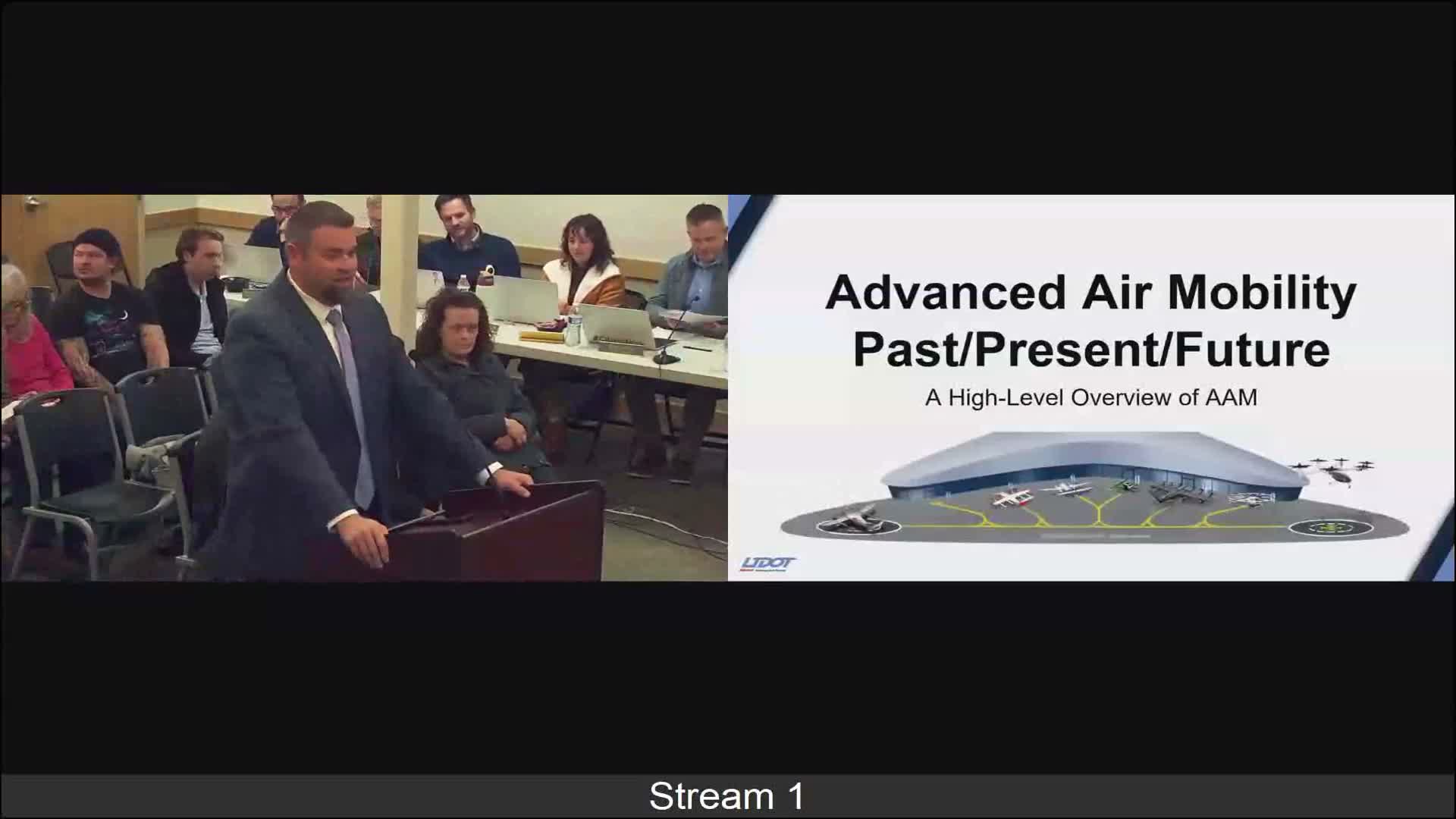
Mayor and council members heard a state and industry briefing Feb. 12 on advanced air mobility, the collection of technologies that includes commercial drones and new electric vertical takeoff and landing aircraft.
Paul Damron, Advanced Air Mobility Program Manager at the Utah Department of Transportation, said UDOT has worked on the issue for about a decade and described recent milestones: "My name is Paul Damron. I work with UDOT's division of aeronautics," he told the council, noting studies commissioned since 2021 to map infrastructure, regulatory and land-use needs. Damron said drone registration rules issued in 2024 became effective Jan. 1 and that UDOT will administer commercial registrations and certificates for operators.
Representatives of 47 g, the statewide aerospace-and-defense trade group, framed the private-sector view. Corianne Edwards, 47 g chief strategy officer, said the organization is bringing industry, academia and government together and flagged a pending economic-impact report showing substantial job and revenue projections. Chris Metz, an industry executive with Project Alpha, said manufacturers such as Beta Technologies have chosen Utah for early partnership and that demonstrations — including a visit by the ALIA aircraft — will be scheduled so residents and officials can see the equipment in operation.
Speakers emphasized that community outreach, local land-use protections and regulatory coordination with the Federal Aviation Administration will determine how and where operations occur. "We will not be preempting what the FAA has mandated through their rules," Damron said, adding that local zoning and vertiport planning are important to prevent incompatible development near aviation facilities.
Council members pressed presenters on where Vineyard could influence siting and noise outcomes. Ian Robertson, director of critical materials at 47 g and a Vineyard resident, highlighted local workforce and supply-chain opportunities and said the organization will work with UVU and other education partners on training pipelines.
Why it matters: the presentation positioned Vineyard to have a formal voice in state and regional planning. Officials described potential use cases ranging from small-package drone delivery and cargo logistics to medical transport, first-responder capabilities and eventual passenger services timed in part to the 2034 Winter Olympics planning horizon.
Next steps: presenters offered to share their slide deck and public videos and made themselves available for follow-up conversations with council staff and residents. Council members agreed to continue discussions and to route resident questions to informal hallway briefings or subsequent work sessions.