Get Full Government Meeting Transcripts, Videos, & Alerts Forever!
Get email alerts on the Community Solar Consolidated Billing topic
No spam. Unsubscribe anytime.
Maryland PSC wrestles with "net crediting" vs. alternative consolidated‑billing models for community solar
Summary
At an administrative meeting, the Maryland Public Service Commission heard extensive testimony from developers, subscriber coordinators, investors and utilities over how to implement consolidated billing for the permanent community solar program. Industry groups urged adoption of a New York‑style net‑crediting (NC1) model; utilities and the Office of People's Counsel raised concerns about payment allocation and service termination risk and urged alternatives or protections.
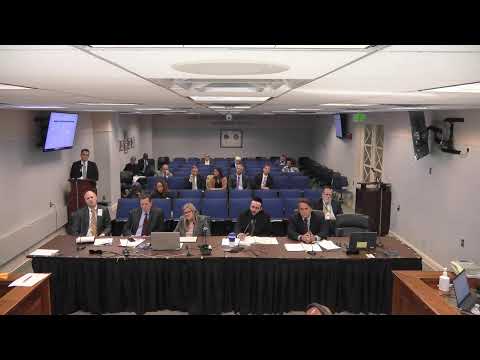
The Maryland Public Service Commission on Nov. 26 convened a lengthy stakeholder panel to decide how to implement "consolidated billing" for the state's permanent community solar program, with competing proposals focused on how bill credits and subscription charges flow between utilities, subscribers and subscriber organizations.
Proponents from the Coalition for Community Solar Access and several subscription coordinators urged the commission to adopt a net‑crediting approach they called NC1, saying it best preserves legislative intent, simplifies customer bills and makes community solar financeable. "It's not hyperbole to say that the success of the permanent program hinges on this decision," David Beagleman of the Coalition for Community Solar Access told the commission. Charlie Coggeshall, representing CCSA, said NC1 is "simple, transparent, [and] proven to work in New York," arguing consolidated billing under NC1 guarantees savings for low‑ and moderate‑income (LMI) subscribers while ensuring subscriber organizations receive monthly payments.
Supporters detailed how NC1 would work on a typical bill: the full community solar credit is applied on the customer's bill, a subscription payment and a small administrative fee are withheld and the remaining "net credit" reduces the customer's electricity obligation. Proponents said that structure preserves guaranteed savings for participants and eliminates the need for subscriber organizations to collect separate invoices or perform credit checks, both of which they said would hinder LMI participation.
Utilities and the Office of People's Counsel (OPC) pressed the commission on a different priority: preventing utility service terminations and limiting the risk that uncollected subscription charges could be socialized to utility ratepayers. Matthew Seager, appearing for Exelon utilities and BGE, described the policy choice as one of risk allocation. "Where do you want the risk to be? The subscriber organizations or our customers?" he asked, describing a model (NC2) that applies credits first to the utility charges and only then to subscription fees as better at reducing disconnection risk.
OPC said NC2 "goes the farthest to reduce terminations" because it applies the bill credit first to charges that, if unpaid, could lead to disconnection. OPC's representative Mark Sheebas said his office favored directing the work group to draft NC2 regulations or otherwise include protections that prioritize utility charges.
Industry speakers countered that NC2 would recreate the worst features of dual billing—delayed benefits, separate invoices and collection burdens on subscriber organizations—and risk undermining LMI participation. Alex Parson of Solstice described Illinois' experience with an NC2‑style system and testified that it has slowed deployment and complicated collections. Investor and owner representatives (CleanCapital, Arcadia) told commissioners that NC1 produces predictable cash flows that attract capital and that markets in New York and New Jersey have scaled under that model.
Staff offered a compromise path: preserve the customer transparency and single‑bill experience of NC1 while using the statutory administrative/transaction charge (nominally 1%) to recover a portion of implementation and collection costs and to protect against undue ratepayer exposure. Philip Vander Hayden, net metering working group leader for staff, urged the commission to give clear direction to the work group so drafting can proceed quickly.
The commission did not issue a final policy decision during the meeting. Commissioners discussed timing pressures—the permanent program's implementation deadlines and a need for regulatory clarity—but left the working group with a request for guidance and a target of producing draft regulations before the end of the year. Chair Hoover said staff would return with a recommended path so rulemaking could proceed.
The panel included multiple exchanges in which presenters were asked to explain how NC1 and NC2 handle low‑income participants, LIHEAP coordination and administrative fees. Proponents highlighted that HB 908 requires participating LMI customers to receive at least a 10% minimum savings and prohibits credit checks; they said NC1 best ensures that outcome. Utilities emphasized the commission must weigh potential increases in bad debt, implementation costs and the consequences for ratepayers if uncollected subscription charges are ultimately recovered through rates.
The commission directed staff and the working group to accelerate drafting and seek a clear policy instruction from the Commission in time to keep the permanent program on schedule.