Get Full Government Meeting Transcripts, Videos, & Alerts Forever!
Get email alerts on the Power Impact Fees topic
No spam. Unsubscribe anytime.
Planning commission backs Power Department's impact-fee update, endorses sharp commercial increase
Summary
Springville planners on Sept. 24 recommended that City Council receive the Power Department's 10-year capital plan and impact-fee analysis, which proposes modest residential fee changes but an approximate 89% increase for many commercial categories; staff said fees must be used within six years and the city will revisit them annually.
The Springville Planning Commission on Sept. 24 recommended the City Council accept updates to the Power Department's capital facility plan, impact-fee facility plan and impact-fee analysis, endorsing staff's recommendation to implement higher commercial impact fees.
Jason Miller, director of the Power Department, told the commission the plan is designed to allocate costs of new incremental infrastructure to new development rather than shifting them to existing ratepayers. "The whole point of the impact fee... is to cover that new incremental cost that would be incurred on a system," Miller said. He described key methodology features including a 'buy-in' credit for existing capacity, panel-loading factors (residential roughly 12–12.85%; commercial about 25%), a 10-year project horizon and the requirement that impact-fee funds be used within six years or returned to developers.
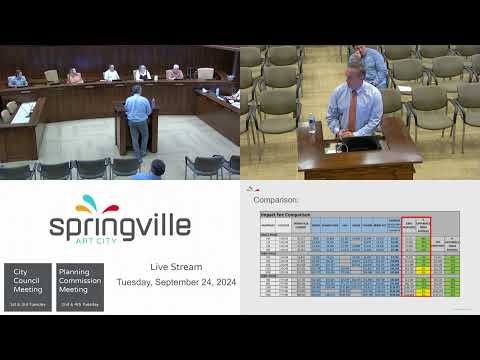
Miller said the 2019 study was updated with more precise panel-loading and buy-in assumptions, and that the proposed changes would leave most residential impact fees nearly unchanged while producing substantial increases on the commercial side — he cited roughly an 89% increase for many commercial categories compared with the current fee schedule. Miller compared Springville's proposed fees with neighboring cities and said the proposed commercial fees remain comparable to or below some regional averages when the full methodology is considered.
Commissioners asked whether upgrades (not just new services) would trigger fees and how the city audits and tracks funds. Miller said upgrades that increase service size would be assessed additional fees; impact-fee funds are tracked against specific projects, the state audits allocations, and staff said there are processes (pretreatment questionnaires, building-code checks and connection agreements) to manage environmental and infrastructure impacts. Commissioners also discussed lead times for equipment (transformers cited at 16–24 months) and whether incentives could offset fees for targeted development; staff said incentives are possible but rare and require other funding sources. The commission voted unanimously to recommend the report and proposed fee changes be forwarded to City Council for action.