Get Full Government Meeting Transcripts, Videos, & Alerts Forever!
Get email alerts on the Utilities topic
No spam. Unsubscribe anytime.
Smithville staff propose 15% water and sewer rate increase as large CIP projects loom
Summary
City staff told the Board of Aldermen the combined water and wastewater fund faces large capital projects and recommended a 15% rate increase in 2025 alongside cash‑flow scenarios that include a COP issuance and consideration of privatization. Staff cited a $1.5 million federal earmark and multiple high‑cost projects driving the request.
City staff presented a multi‑year plan for the combined water and wastewater fund and proposed a 15% rate increase for 2025 to cover planned capital improvements and rising operating costs. The work‑session presentation laid out a five‑year capital improvement program (CIP), several immediate lift‑station projects and cash‑flow scenarios that would use a certificate of participation (COP) issuance if needed.
Director/staff presenter (speaker 7) identified key CIP items for 2025, including the Maple Avenue and river crossing (noted as 50% of that expenditure placed in impact fees) and the Hundred and 40 Fourth Street lift station, for which staff said there is a $1,500,000 federal earmark. "We do have federal earmark money of 1,500,000.0," the presenter said, and listed a 2025 net projected CIP for the combined fund of roughly $5,100,000. Looking farther ahead, staff showed projected CIP expenditures of about $3,300,000 for 2026 and a larger $7,700,000 year projected in 2027.
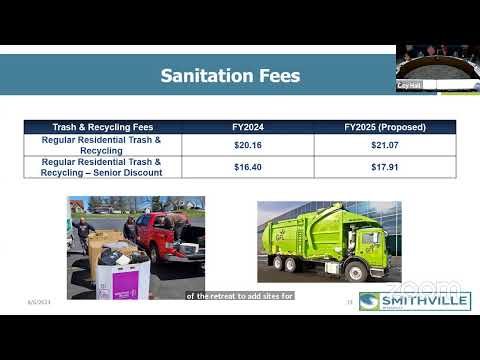
On rates, staff said the 2022 rate study forecast roughly 15% increases for water and sewer through 2029 and that staff is proposing that 15% step in 2025. The presenter gave concrete examples: a fixed monthly water charge rising from $14.70 to $16.91 and the volume charge for water moving from $10.40 to $11.96 per 1,000 gallons under the proposed 15% increase. The presenter also reported the average combined bill (water, wastewater and trash) would be about $149 if the proposed adjustments are adopted.
Staff walked the board through two cash‑flow scenarios: one that assumes a 15% rate increase plus a COP issuance of roughly $4.3 million and another that delays COP issuance and examines privatization options. In the COP scenario, staff reported the fund remains above the target reserve; in the delayed‑COP scenario reserves could be stressed in later years. "As we think about privatization, we're... looking pretty heavily at privatization," the presenter said, adding that delaying a COP could save issuance cost but would require close monitoring.
Staff emphasized that the utility funds are supported primarily by user charges, not property or sales taxes. "Our water and wastewater utility are funded solely through user charges," a member of staff (speaker 8) told the board and reminded listeners that grant funding has helped but does not replace user revenue. Staff also noted approximately 63 sewer‑only customers and 19 water‑only customers who would be affected by fee changes, and reaffirmed a 15% senior discount currently included in proposals.
Board members pressed staff on alternatives, including scaling back capital projects to defer rate increases, the consequences of further delays and the risks of deferred maintenance. Engineering staff flagged four immediate wastewater projects that are driving near‑term costs: the Hundred and 40 Fourth Street pump station, the Hills Shannon/daycare lift station, replacement of the Smiths Fork force main and an additional river crossing to add system redundancy.
Staff said the budget timeline will move the rate review through a public hearing and a first reading in October, with initial budget discussions continuing in August and September. The work session closed with staff noting the figures are fluid and will be reassessed as grant outcomes, privatization analysis and market conditions evolve.
Next steps: staff will present the formal rate proposal, publish details for the public hearing and return with refined cash‑flow scenarios and project prioritization in upcoming meetings.