Get Full Government Meeting Transcripts, Videos, & Alerts Forever!
Get email alerts on the Nuisance Ordinance topic
No spam. Unsubscribe anytime.
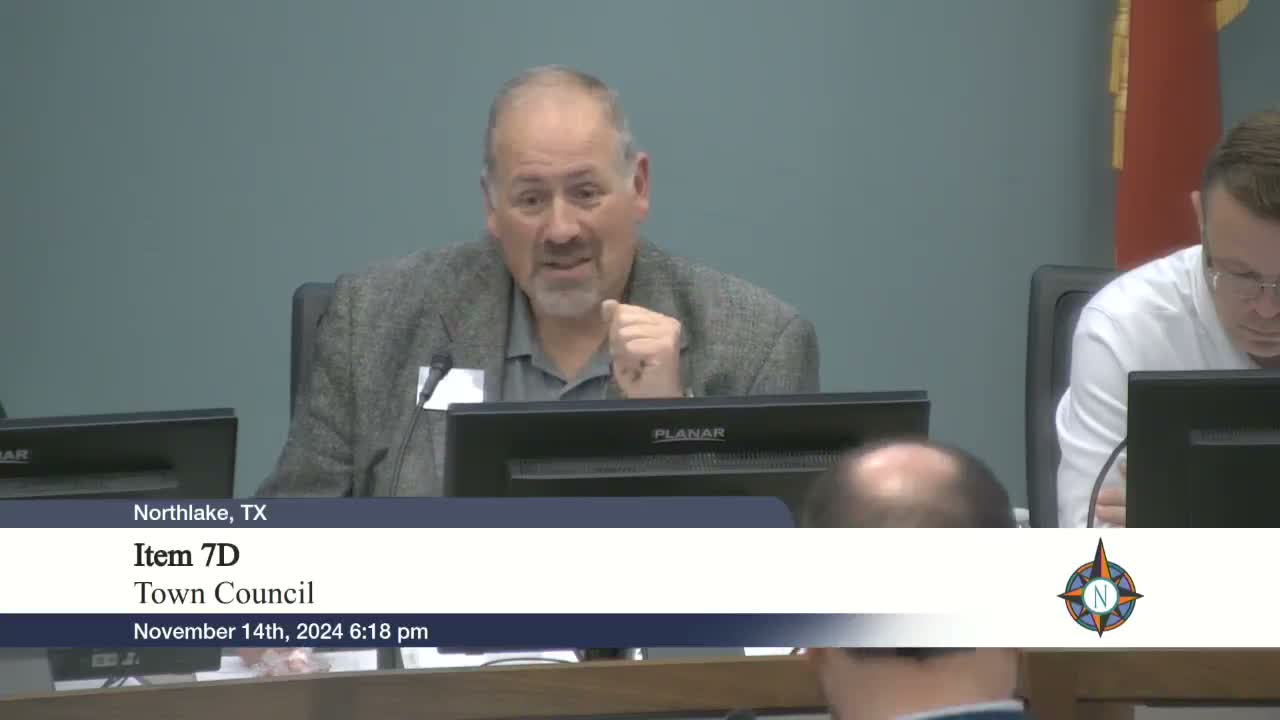
Northlake council discusses expanding nuisance rules beyond limits, including decibel or time limits to curb late-night noise
Summary
Legal staff proposed amending Northlake’s ordinances to declare specific noise and lighting violations a nuisance up to 5,000 feet beyond town limits and to add objective standards (decibel and foot-candle limits); residents at public comment described a nearby concert venue that shakes windows and urged action.
Council received a legal briefing on updating nuisance regulations so Northlake can enforce noise and outdoor-lighting standards up to 5,000 feet beyond town limits as state law permits for home-rule cities. Nathan (legal, speaker 10) reviewed the authority and proposed amendments to Article 8.02 to declare specified noise and lighting violations a nuisance and to add objective measures to support enforcement.
Nathan noted the state penal code sets an 85-decibel threshold as an objective standard for certain state enforcement and recommended options for the town to adopt either a single maximum level or time- and zoning-differentiated limits (day/night and residential vs. nonresidential). "There is a regulation in the state penal code... that sets a threshold of 85 decibels," Nathan said, and he proposed adding objective decibel or foot-candle standards to the code to make enforcement clearer and to apply the rules up to 5,000 feet beyond town limits where allowed.
Council discussed practical enforcement: Chief Crawford said the department receives many complaints and will purchase decibel meters to support enforcement, but emphasized a warning-first approach for most calls. Councilmembers debated an appropriate nightly cutoff (many favored 10 p.m. on weeknights with holiday exceptions). Staff warned that expanded enforcement could require more code-enforcement personnel or overnight shifts and asked council for guidance on time limits and exceptions.
Residents used the public-comment period to describe the problem in concrete terms. Joel McGregor told council he lives about a mile from Texas Motor Speedway and that loud events are audible indoors; he urged caution so longstanding uses are not unfairly penalized. Another resident described a new concert venue behind his home whose bass "shakes windows" and prevents children from sleeping; staff acknowledged that low-frequency bass is a common enforcement challenge.
Staff will draft ordinance language that clarifies which violations are nuisances beyond town limits, includes objective standards for noise and lighting and proposes reasonable time windows and exception language for special events. Council gave staff direction to research peer cities’ experiences and the budget implications of additional enforcement and to return with a draft for more detailed review.