Get Full Government Meeting Transcripts, Videos, & Alerts Forever!
Get email alerts on the Landfill And Risk Management topic
No spam. Unsubscribe anytime.
ACUA president says gas-collection upgrades, capping bid and RNG plan will reduce emissions but not immediately eliminate odors
Summary
Matthew Tahoe, president of the Atlantic County Utilities Authority, told the Board of Commissioners that expanded gas wells, a planned 16-acre capping project advertised for bids and a renewable natural gas facility due in 2025 should improve collection and cut emissions, though odors may persist in some conditions.
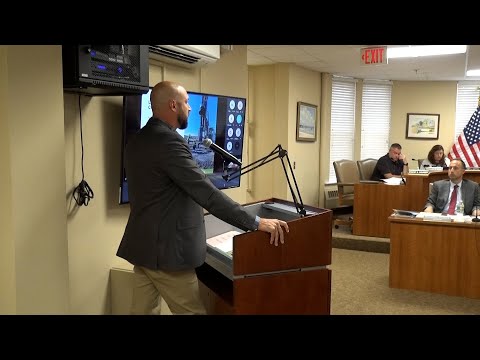
Atlantic County Utilities Authority President Matthew Tahoe told the Atlantic County Board of Commissioners on the meeting that ACUA has expanded gas-collection infrastructure and is preparing a 16-acre landfill capping project and a renewable natural gas (RNG) facility intended to cut emissions by converting methane for pipeline use.
"We have over a 110 gas wells in our entire site," Tahoe said, describing a system of headers and wells across the 102-acre site and a recent push to redrill more than 30 wells and add nearly a half-mile of 18-inch header pipeline. He said the work is meant to increase vacuum and collection efficiency so gas is captured rather than migrating off-site.
Tahoe said heavy rain triggered unusually high gas production earlier in the year; crews installed 19 wells in February and have been addressing erosion and side-slope stability. He also described third-party surface-emissions monitoring at roughly 640 points, with 179 penetrations inside the landfill. "We had 2 points out of almost 700 points" over threshold in February, he said, and recent draft reporting showed "6 points" above limits that crews promptly fixed.
On fence-line standards, Tahoe cited the requirement to stay within 30 parts per billion at the fence line and explained the staged response when exceedances occur, including repeat testing and neighborhood monitoring. He emphasized that monitoring is done by outside consultants and the site operates under NJDEP-approved plans.
Tahoe announced that bids opened the day of the meeting for a 16-acre capping project on the easterly portion of the landfill, with a bid-opening scheduled for Oct. 31 and construction expected to start in the first quarter of 2025. He said the county has authorized approximately $4,500,000 toward capping and that the project must be awarded before the end of the year to meet ARPA funding rules.
On the RNG project, Tahoe said the county broke ground on infrastructure in October and expects the RNG facility online in August 2025. "Once we collect all that gas, right now it's being flared," he said. Converting the gas to pipeline-quality RNG will, he said, eliminate the flare and reduce onsite emissions by about 95 percent.
Commissioners asked whether capping would eliminate off-site odors. Tahoe cautioned that capping helps efficiency but "is not a silver bullet," noting that odors can be detectable to the human nose at levels well below regulatory exceedance thresholds. He also clarified that ACUA is permitted to accept waste until roughly July 2029 and said staff are evaluating options such as waste diversion and conversion to extend capacity but are not submitting an expansion now.
Tahoe said the agency intends to be transparent with residents, posting weekly updates on construction and activities that could temporarily increase off-site odors and sending targeted emails when work might elevate the risk of detectable smells.
Next steps: bids for the capping project will be opened Oct. 31; award must be made before year-end to meet ARPA conditions, and the RNG facility is scheduled for operation in August 2025.