
Winona board previewed new CTE and concurrent-enrollment courses, including firefighter certification pathway
Get AI-powered insights, summaries, and transcripts
Subscribe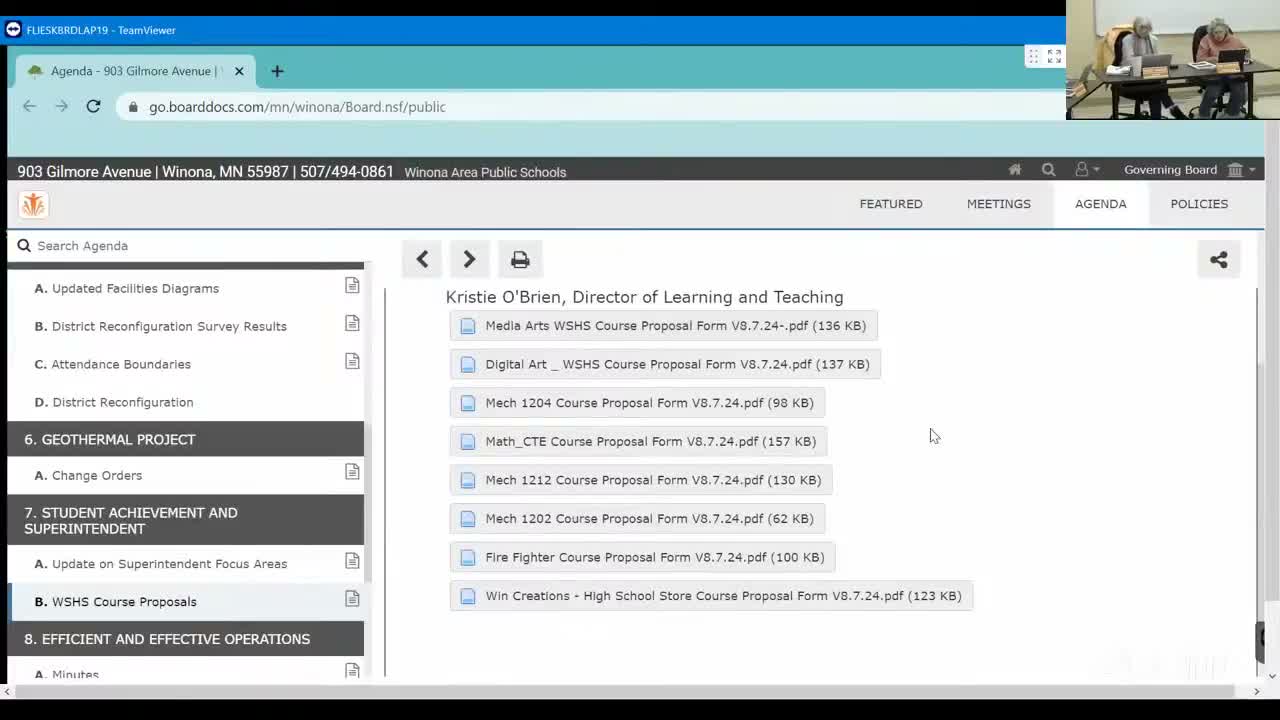
Summary
Trustees heard proposals to expand career and technical education: separate digital and media arts courses, a maker 'wind creations' program, Medtronic-aligned electronics concurrent-enrollment, a geometry+construction pathway (tiny-house/shade projects), and a firefighter 1/2 + HAZMAT concurrent-enrollment track with hands-on certification hours.
The board reviewed a package of course proposals aimed at expanding career and technical education opportunities for secondary students.
Curriculum staff said the graphics/media sequence will be split into two distinct courses (digital arts and media arts) to give students more chances to deepen skills in either field. CTE leaders described a new "wind creations" maker-course that formalizes recent independent-study projects and would partner with local businesses to provide CNC and production expertise.
District staff are pursuing Medtronic-aligned electronics courses as concurrent-enrollment options with Minnesota State Southeast; those classes would provide students hands-on circuitry and soldering experience and place them on a pathway to further postsecondary credentials. Another proposal combines geometry and construction so students apply geometric principles in a real-world building project (tiny homes/sheds). Staff said the geometry+construction pathway would require staff training (estimated ~$10,000) and a year of planning before full implementation.
Notably, the board reviewed a firefighter 1/2 and HAZMAT concurrent-enrollment pathway offered through Riverland (Riverview Community College). The firefighter sequence is three concurrent-enrollment courses with asynchronous classroom work, seven days of hands-on skill sessions and a culminating controlled burn; students who complete course and assessments could earn firefighter certifications recognized by local departments. Staff clarified the concurrent-enrollment stipend structure (three courses, not one) and estimated approximately $9,000 in concurrent-enrollment fees for the district’s portion in the first year plus textbook/access costs.
Board members raised safety and liability questions about hands-on fire training, class-size caps (staff suggested a 10–15 student cap), integration with special-education services, and whether the geometry+construction pathway would maintain college-preparatory rigor. Staff and board agreed to refine cost estimates and safety/insurance documentation prior to a formal vote.
What’s next: the proposed courses will return for board action at the next meeting with updated cost figures and any required agreements for concurrent-enrollment partners.