Get Full Government Meeting Transcripts, Videos, & Alerts Forever!
Get email alerts on the Accessibility topic
No spam. Unsubscribe anytime.
South Carolina Arts Commission and ABLE South Carolina outline six practices to boost organizational accessibility
Summary
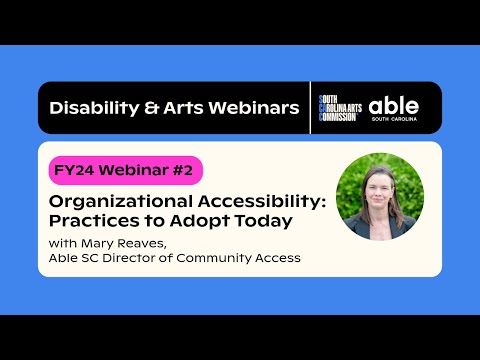
In a webinar hosted by the South Carolina Arts Commission, ABLE South Carolina presented six practical steps for arts organizations—board inclusion, disability advisory committees, accessible policies, a designated accessibility coordinator, professional development, and inclusive hiring—plus resources and follow-up office hours.
The South Carolina Arts Commission and ABLE South Carolina used a statewide webinar on Nov. 6 to urge arts organizations to take concrete, leadership-driven steps to make programs and facilities more accessible to people with disabilities. Mary Reeves, director of community access at ABLE South Carolina, laid out six interrelated practices organizations can adopt: board inclusion, disability‑inclusive advisory committees, written accessibility policies, a designated accessibility coordinator, intentional professional development, and inclusive hiring practices.
Reeves said board-level commitment is essential to lasting change, recommending governance charters explicitly include accessibility and encouraging boards to cultivate an environment where voluntary self‑identification is safe. “You cannot ask a person if they have a disability,” Reeves said, adding that organizations should instead destigmatize disclosure and create ways for people to volunteer that information.
On advisory committees, Reeves advised organizations to set clear scopes for advisers, recruit people with diverse lived experiences and relevant expertise, and clarify decision‑making so volunteers understand whether their advice will be acted upon. She also recommended compensating advisers for their time and surveying them afterward to avoid tokenization.
Reeves walked through a checklist for policies and procedures that can unintentionally exclude participants: strict material or tool requirements for classes, rigid attendance or audition rules, inaccessible instructional materials, and barriers to technical or backstage roles. She urged organizations to adopt written processes for accommodation requests, define when a requested modification would be a “fundamental alteration” or an “undue burden” consistent with ADA language, and include an appeals or compliance review process.
The session recommended identifying a designated accessibility coordinator — sometimes called an ADA coordinator — to field complaints, coordinate accommodations, lead self‑evaluations and transition planning, and provide staff training and public notice about accessibility practices. Reeves noted that Title II public entities with 50 or more employees are required to have an ADA coordinator, but she said smaller organizations also benefit from a clear point person to make timely decisions about interpreter bookings, captions, and other supports.
Professional development should be tied to measurable change, Reeves said, with training led by people or organizations with disability leadership when possible. “If you don’t fund it, you don’t do it,” she added, urging organizations to include accommodation budgets and to measure outcomes so training changes practice rather than merely checking a box.
On hiring, Reeves suggested accessible job applications and postings that explicitly encourage candidates with disabilities to apply, along with clarifying essential job functions (rather than default physical requirements) and ensuring accommodations are promptly available during recruitment and on the job.
The webinar also included a brief knowledge check poll for attendees: all respondents said they knew the definition of disability; most reported knowing how to provide accommodations; fewer reported having written accessibility policies or regular inclusion training. Presenters posted resource slides, announced office hours for continued discussion the next day, and said a recording would be available within a few days.
Amanda Noyes, arts and education accessibility director at the South Carolina Arts Commission, framed the session within SCAC’s Arts for All SC grant work and encouraged organizations unsure where to start to contact SCAC or ABLE South Carolina for guidance. The webinar closed with an invitation to upcoming sessions on digital regulations, assistive technology, and budgeting for accessibility.