Get Full Government Meeting Transcripts, Videos, & Alerts Forever!
Get email alerts on the Occupancy Standards topic
No spam. Unsubscribe anytime.
University Park residents press council to enforce occupancy rules near SMU
Summary
Neighbors urged University Park leaders to enforce or rewrite the city's occupancy ordinance after years of alleged over-occupancy, parking spillover and trash at multi-unit properties near SMU; council heard extensive public comment but took no vote on the discussion item.
Dozens of University Park residents told the City Council on Nov. 19 that newly built duplexes and multi-bedroom rental units near Southern Methodist University are being populated by multiple students in apparent violation of the city's occupancy ordinance and that enforcement has been inconsistent.
Residents cited persistent parking, trash and party-related problems and asked the council to either enforce the current ordinance or rewrite it so it can be enforced. "They feel very comfortable not complying with the ordinance set forth years ago by our local government," said Lisa Boyer, a Milton Avenue resident, who singled out a 3,200-square-foot duplex she said is owned by SBRJ Inc. and managed by M Streets LLC. "Please help us."
The petitioners and neighborhood speakers presented photographs, repeated license-plate observations and a slideshow documenting cars parked in yards and on sidewalks, overflowing trash and property damage. Nasi Agarides asked the council to adopt a vehicle-based test used in College Station (for example, a threshold of repeated vehicle presence within a 30-day period) and to require owner-registered parking decals and landlord accountability to prevent "ghost leasing." Max Fuquay recommended treating large rental properties as business operations so the city can inspect and regulate them more like other commercial landlords.
City staff provided a history of earlier council and committee work. Patrick Ball summarized past steps dating to a 2005 ordinance, multi-year committee reviews in 2006–2007, and a 2020 lawsuit settled in January 2022 that gave staff limited authority to request and monitor rent rolls; Ball noted that settlement is set to sunset in January 2025. "That settlement will sunset January of 2025," Ball said, adding that staff has been monitoring certain properties and coordinating with third-party managers.
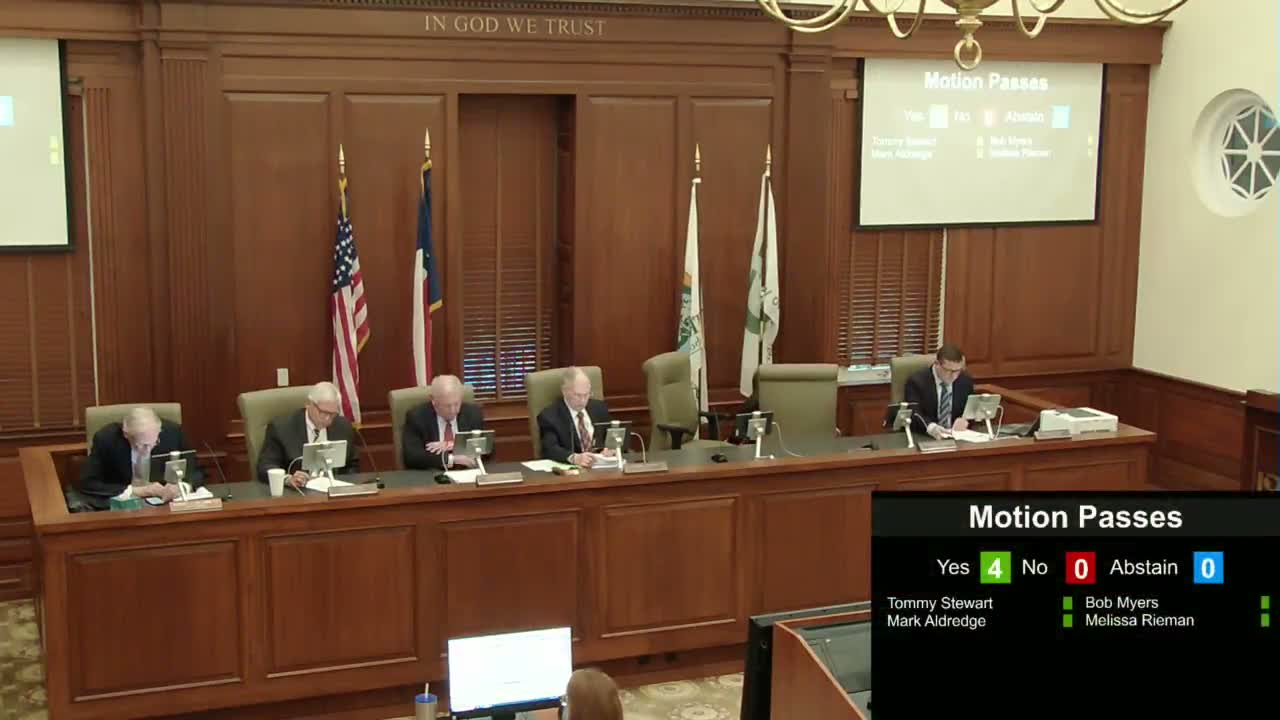
Mayor Tommy Stewart told residents the item was for discussion and that the council would not vote on changes that night. "Give us a little time. We'll work on it," he said. The council did not adopt any ordinance or formal enforcement action during the meeting.
What happens next: Council members and staff signaled they will review enforcement options and potential code revisions. Residents requested that the city consider parking decals for affected streets, clearer definitions of "residence" (by vehicle presence), removing temporary hang tags for multi-house units, and clearer mechanisms to hold landlords contractually responsible.
Speakers quoted: "We are asking that you, as our city leaders, listen to our concerns and frustrations, and please find a common sense solution to this issue," Lisa Boyer said. "We're asking that the concerns of the residents don't fall on deaf ears just because it's not an easy issue to fix," Leslie Agaridis added.
The discussion closed with no formal action; the council moved to the next agenda item.