Get Full Government Meeting Transcripts, Videos, & Alerts Forever!
Get email alerts on the Land Use 326 Ferry Boulevard topic
No spam. Unsubscribe anytime.
Stratford commission keeps hearing open on plan to move boat sales and service to 326 Ferry Boulevard
Summary
Attorney Peter Harvey and contract purchaser John Brown asked the Stratford Zoning Commission to permit sale, storage, service and display of boats at 326 Ferry Boulevard; the commission kept the public hearing open after hearing EPA‑remediation and aesthetic concerns and asked the applicant for more documentation.
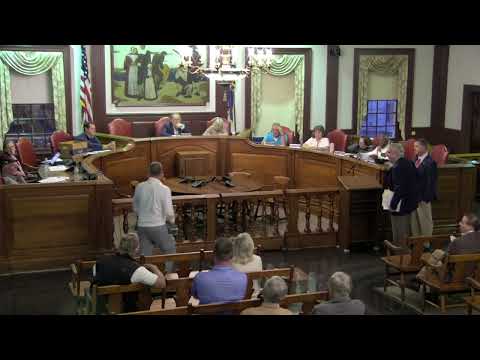
Attorney Peter Harvey and a contract purchaser asked the Stratford Zoning Commission on Oct. 23 to allow a relocated boat sales and service business at 326 Ferry Boulevard, arguing the use would reuse an otherwise blighted property and fit Ferry Boulevard’s longstanding marine character. The commission voted to keep the public hearing open so the applicant can provide additional EPA documentation and more-detailed plans for screening and operations.
Harvey said he represents the contract purchasers and that they are seeking both a zoning text amendment to permit the sale, storage, service and display of boats in a CA mixed‑use zone and special‑case approval to carry out those uses at 326 Ferry Boulevard. "We're only relocating an existing business that has existed on the street for 3 decades," Harvey said, and he described dust‑containment, double‑wall waste‑oil storage and runoff‑capture measures the business would use.
Attorney Robert Rosati, representing the record owners, said EPA remediation of the site has concluded but that a land‑use restriction will be recorded that limits residential use of the rear portion of the property. Rosati told commissioners that combining the two parcels is a condition of the EPA agreement and that "close to 2 of the acres are gonna be subject to this land use restriction," making mixed residential development economically infeasible on the larger rear parcel.
Commissioners and staff pressed for specifics. Planning and zoning administrator Jay Obanske said the submitted survey does not clearly show the exact boundary of any land‑use restriction and that he could not confirm which portion of the rear 1.7‑acre parcel would be restricted. Commissioners also asked whether boats would be stored indoors or behind screening; several members said they have approved indoor-storage requirements for recent marina/boat‑service approvals and said such controls help with aesthetics and pollution prevention.
Nearby residents offered mixed views. Joe Vernuccio, who said he and his neighbors are "not opposed to this project," urged green fencing, screening and beautification of the property’s perimeter if the commission approves the application. Thomas Legensky, a resident who opposed rear‑parcel use, cited the site's history of industrial contamination and said he did not want to see boats and repair activity on the back parcel.
Given outstanding questions about the scope of the EPA land‑use restriction, the exact parcel area affected, and the visual and operational details (number and size of boats, ingress/egress methods, and screening), the applicant asked the commission to keep the hearing open to submit additional documents and a definitive EPA opinion. A motion to continue the public hearing and keep the public portion open passed on a unanimous voice vote (5–0).
Next steps: the applicant will submit further documentation into the record for distribution to commissioners; staff asked for amended plans showing screening, the expected number and sizes of boats, and how boats would be brought to and from the site so the commission can assess traffic, visual and environmental impacts before a final vote.