Get Full Government Meeting Transcripts, Videos, & Alerts Forever!
Get email alerts on the Floor Votes Roundup topic
No spam. Unsubscribe anytime.
Votes at a glance: House passes supplemental appropriations, bond authorization and multiple bills; several items circled for later
Summary
On the floor the House passed a package of bills including the Current Fiscal Year Supplemental Appropriations Act (SB3), a general-obligation bond bill for a Utah State University agricultural building (SB4), and several other measures; vote tallies and brief descriptions are listed for quick reference.
The Utah House concluded a busy floor session with votes on multiple measures and several procedural actions. Key outcomes and short descriptions follow.
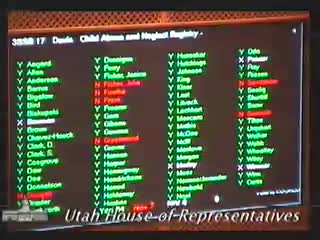
• Senate Bill 17 (third substitute) — Child Abuse and Neglect Registry: substituted and passed 64–7 (For detailed debate see separate article).
• First Substitute Senate Bill 264 — Development Around Military Installations: cleanup language to allow the Military Installations Development Authority to contract with bordering counties and cities for infrastructure and services; passed this body 70–0.
• Senate Bill 265 — Unlawful Detainer Amendments: clarifies last year’s law at the request of the Administrative Office of the Courts; passed 71–0.
• Senate Bill 3 — Current Fiscal Year Supplemental Appropriations Act: adjusts appropriations for the fiscal year ending June 30 and corrects items such as prior library funding shifts; passed 68–1.
• Senate Bill 4 — General Obligation Bond Authorization: authorizes state bonding to cover the state share of a new agricultural building at Utah State University; sponsor said the federal government is expected to contribute between $60 million and $100 million and the bond language forbids spending state proceeds until federal funds arrive; passed 65–7.
• Second Substitute Senate Bill 185 — Economic Incentive Revisions: converts certain business recruitment incentives from rebates to tax credits, tightens reporting requirements across state fiscal offices and involves the State Tax Commission in verification; passed 69–0.
• Third Substitute Senate Bill 46 (as amended) — Anti flow-control amendments: House reconsidered to add a missed amendment about landfill-availability conditions; amendment adopted and the amended bill passed 70–2.
Several other bills were placed on the third-reading calendar under suspension of the rules or were circled for later consideration (including Fourth Substitute Senate Bill 38, Transparency in Government, and First Substitute Senate Bill 2, Minimum School Program Budget Amendments). The House adjourned until 8 a.m. the following day.