Get Full Government Meeting Transcripts, Videos, & Alerts Forever!
Get email alerts on the Cultural Artwork topic
No spam. Unsubscribe anytime.
Artist David Koch explains symbolism behind two new Utah House murals
Summary
At the Utah House on Jan. 30, artist David Koch described the historical subjects and symbolic choices behind two new chamber murals — one honoring Sarah F. Young and women's suffrage in Utah, the other depicting Alf Engen and the rise of winter recreation — and the House voted to enter his remarks in the journal.
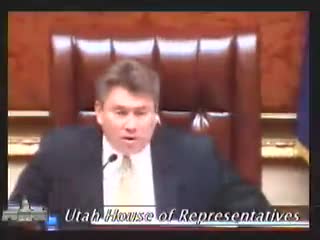
Artist David Koch visited the Utah House chamber on Jan. 30 to explain the themes and historical references in two new murals installed over the House floor.
Dressed in the chamber for a brief, invited presentation, Koch said the north mural depicts Sarah F. Young voting in 1870 and employs a pair of windows as a visual metaphor: one open, one closed, representing two distinct "windows of opportunity" for Utah women. The south mural depicts Alf Engen and his brothers building a ski jump on Ecker Hill; Koch said he intended it to represent a broader economic shift from mining to winter recreation. "My objective also was to portray opportunity, possibility, vision and planning and hard work," Koch said.
Koch walked members through specific figures and details he included: Emmeline B. Wells, Sarah Kimball and Emily Richards (portrayed on a stairway) to represent the later suffrage struggle; a man shown as Acting Governor Stephen A. Mann; and visual cues in the Engen mural such as a Deseret News Ski School bib and a 2002 Olympic beret. He said he chose composition and local architectural references, including Council Hall where the original vote took place, to anchor the work in Salt Lake City.
Lawmakers responded with appreciation and brief questions; Representative Wiley asked whether the murals were signed, and Koch identified signatures in the lower left below the flagpole and on timbers near a corner. Representative McGee moved that Koch's remarks be spread upon the pages of the House journal; the motion passed by voice vote.
The presentation was heard while the House briefly resolved into a Committee of the Whole to accommodate the visit and then resumed regular business. Speaker and several members praised the contribution as a historic and educational addition to the Capitol art collection.
The House recorded the presentation in its journal and will return to its legislative calendar on Jan. 31.