Get Full Government Meeting Transcripts, Videos, & Alerts Forever!
Get email alerts on the Healthcare Reform topic
No spam. Unsubscribe anytime.
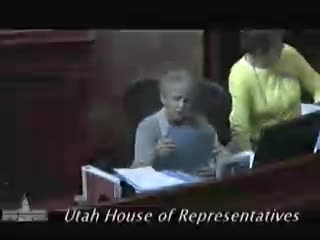
Utah House Approves Health Reform Measures; HB165, HB188 and HB331 Move to Senate After Floor Debate
Summary
The Utah House passed several health-reform measures Feb. 18: First Substitute HB165 (administrative simplification) passed 72-0; First Substitute HB188 (insurance-market reforms, portal and risk-adjuster) passed with recorded tally 64-4 (transcript contains a bill-numbering anomaly; vote applies to HB188); Second Substitute HB331 (state-contract insurer coverage incentives) passed 58-12. Debate included amendments, concerns about limited-benefit plans and risk sharing.
The Utah House spent much of its Feb. 18 floor session debating and voting on a package of health-reform measures aimed at administrative simplification, market transparency and incentives for employer-provided coverage.
First Substitute House Bill 165, described by the sponsor as an administrative-simplification measure, passed the House by a recorded vote of 72-0. The bill requires clearer standards for information exchange among insurers, providers and patients; creates a demonstration project for alternative payment and delivery models; standardizes coordination-of-benefit rules (notably a birthday-month tiebreaker) and requires insurers to provide current coverage information to providers. Sponsor remarks noted the measure is not effective until July 1, 2010 for certain provisions: "It is not effective until, 07/01/2010," the sponsor said on the floor. The sponsor also told members the bill aims to reduce administrative costs that can be ‘‘approximately 20% to 25%’’ of health-care spending.
The House then debated First Substitute House Bill 188, a broader insurance-market reform that would establish a defined-contribution portal for small employers and individuals, create a basic "net care" (mandate-lite) option alongside full plans, require a universal application, and authorize a risk-adjuster mechanism to limit adverse selection among participating insurers. Floor amendments were adopted (including a sponsor amendment and an amendment that narrowed the definition of products subject to disclosure). Lawmakers pressed the sponsor about portability, risk adjustment and whether the portal would transfer funds among companies; the sponsor explained that the bill sets up an industry-agreed risk-adjuster mechanism and tools such as reinsurance and actuarial measures to mitigate adverse selection.
After extended debate, voting was opened and closed; the transcript records the final announcement as, verbatim, "HB166 passes this body with 64 yes and 4 noes and will be referred to the Senate." Audit review of the transcript shows that the floor action immediately preceding the vote was on First Substitute HB188; the closing announcement appears to contain a bill-number transcription error (the vote tally and surrounding context correspond to HB188). The House's recorded tally for that floor action is 64 yes and 4 no and the measure was referred to the Senate.
The House also adopted Second Substitute HB331, a policy to encourage employers who provide insurance by favoring compliant contractors in large state procurement. The substitute clarifies that penalties for violations apply to the contracting party that committed the violation (not to unrelated subcontractors), sets thresholds for applicability ($750,000 for subcontract contracts; $1.5 million for general contracts), and permits an alternative high-deductible/HSA approach provided the employer funds 75% of the premium. The second substitute passed on the floor, the clerk announced, with 58 yes and 12 no votes and was referred to the Senate.
On the floor, many members expressed support for the task-force process that produced the bills and asked for narrative summaries to share with constituents. Concerns most frequently voiced were the potential for limited-benefit "mandate-lite" plans to leave people underinsured, the complexity and fairness of the risk-adjuster, and the need to preserve portability and protections for people with pre-existing conditions. Members also requested further work by the task force and administrative bodies to refine technical details during the interim.
Next steps: the measures passed by the House will be transmitted to the Senate for consideration; the committee/task-force provisions in some bills anticipate further interim work and reporting back to the Legislature.