Get Full Government Meeting Transcripts, Videos, & Alerts Forever!
Get email alerts on the Water Resources topic
No spam. Unsubscribe anytime.
Contested Narrows Reservoir resolution passes the House despite opposition from Carbon County lawmaker
Summary
House Resolution 1 supporting the Narrows Reservoir project passed 54–16 after extended debate. Opponents raised environmental and local economic concerns — including trout spawning impacts and risks to nearby mining and power-plant operations — while the sponsor cited adjudicated water rights and prior intercounty agreements.
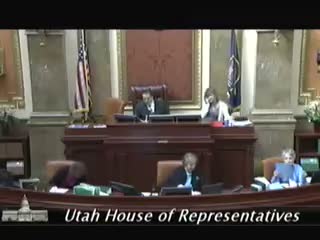
The Utah House on Jan. 30 approved House Resolution 1 (HR1), a statement supporting the Narrows Reservoir project in central Utah, after floor debate that highlighted a sharp divide between Sanpete County proponents and Carbon County opponents.
The sponsor framed HR1 as a fairness and water-storage measure. "Is the water clearly Sanpete's? Yes," the sponsor said, asserting that 5,400 acre‑feet had been adjudicated to Sanpete County and that an independent engineering study recently reaffirmed the project's location and feasibility. The sponsor urged support for federal assistance to build the reservoir, saying Sanpete County was prepared to seek repayable federal loans.
Representative Watkins, speaking from Carbon County, urged the House to oppose the resolution. Watkins said the proposed Gooseberry Narrows Dam and reservoir could deliver approximately 89% of the stored water to a small number of agricultural users to expand alfalfa production, would destroy 20 miles of rainbow and cutthroat trout spawning habitat, and might divert water that supports a regional power plant. Watkins warned mining operations, royalties and local jobs could be jeopardized and predicted lengthy litigation from non‑governmental organization challenges if the Legislature backed the project now.
The sponsor rebutted by citing a 1984 agreement signed by both Carbon and Sanpete counties and the recent engineering study. After debate the House voted to approve HR1; the floor recorded 54 yes votes and 16 no votes. The resolution constitutes a formal expression of the House's view and does not itself authorize construction or funding; subsequent federal or agency approvals and any project-specific environmental reviews remain necessary.
Observers and stakeholders interested in water rights, agricultural irrigation, fisheries and local economic impacts will likely follow the resolution as it moves to the Senate or prompts further action by local and federal agencies.