Get Full Government Meeting Transcripts, Videos, & Alerts Forever!
Get email alerts on the State Legislation topic
No spam. Unsubscribe anytime.
Utah House passes package of bills on youth protections, sheriff qualifications, water adjudication and trade resolution
Summary
On Jan. 27, 2009, the Utah House passed multiple bills including changes to penalties for material harmful to minors, new shelter authority for runaway youth, a revision to sheriff‑qualification training, reforms to water‑rights adjudication deadlines and a resolution urging withdrawal of WTO gambling commitments; most measures were transmitted to the Senate.
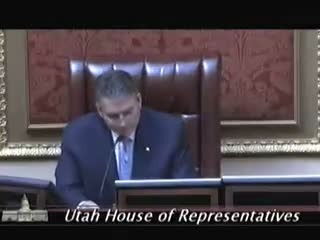
SALT LAKE CITY — The Utah House of Representatives on Jan. 27 advanced a broad set of measures, voting to pass bills that ranged from juvenile‑justice reforms to changes in sheriff qualification requirements and a resolution addressing international trade commitments on gambling.
Lawmakers began the day with routine opening ceremonies and procedural announcements before moving through a succession of bills on the third‑reading calendar. Representative Garn described House Bill 250 as “just basically a cleanup bill,” and the House approved it by voice vote.
Several debated measures that drew detailed sponsor explanations also cleared the chamber. Representative (8) — the sponsor of House Bill 14 — said the bill changes penalties for distribution of pornographic material by age to encourage reporting and treatment instead of harsh adult penalties, moving some younger offenders into juvenile court. “If a person is 16 or 17 years of age, we change that to a Class A misdemeanor,” the sponsor said; the House voted to pass HB14 (74 yes, 0 no) and transmitted it to the Senate.
On youth homelessness, Representative Falk urged support for House Bill 22, which allows shelters for homeless youth to keep minors younger than 18 overnight when necessary so they will not be turned out at 7 p.m. The sponsor cited national statistics on runaway youth and said the change is intended to improve safety and access to shelter services; HB22 passed (74 yes, 0 no).
Republican Representative Greenwood explained changes in House Bill 12 that broaden sheriff‑qualification options by allowing completion of a 40‑hour Correctional Facility Manager course (including online delivery) as an alternative qualification path and by permitting appointees to complete required coursework within 30 days of appointment. An amendment clarifying effective dates and online course availability passed; HB12 later passed the House (72 yes, 0 no).
Representative McKiff framed House Bill 19 as a legislative response to a recent Utah Supreme Court decision, saying the bill removes an absolute two‑year dismissal rule for water‑rights adjudications and replaces it with a rebuttable presumption that allows courts, under a “totality of the circumstances” standard, to grant additional time when appropriate. “It has been a drop dead deadline,” McKiff said of the prior statute; the House passed HB19 (72 yes, 0 no).
On federal compliance issues, Representative Keiser said House Bill 30 updates state commercial‑vehicle definitions and inspection authority to conform with federal regulations after a U.S. audit; HB30 passed (71 yes, 1 no). Representative (5) said House Bill 25 aligns state penalties for certain gun‑dealer paperwork errors with federal law (the Brady Act); HB25 passed (74 yes, 0 no).
The chamber also adopted committee reports and sent a number of bills to standing committees or the consent calendar. Representative Grover’s House Bill 43, which coordinates municipal and special district election dates and polling places “whenever feasible,” was amended and passed. The House adopted HJR1, a resolution introduced by Representative Allen urging U.S. withdrawal of World Trade Organization commitments on gambling and expressing concern about undisclosed terms tied to prior U.S. withdrawal efforts; HJR1 passed 72‑0 as recorded in the transcript.
Votes at a glance (as announced on the floor): House Bill 250 (Revisor Statute) — passed, 72‑0; HB12 (County Sheriff Qualifications) — passed after amendment, 72‑0; HB14 (Material Harmful to Minors Amendments) — passed, 74‑0; HB16 (Assessment Area Amendments) — passed, 74‑0; HB19 (Water Rights: Informal Adjudication) — passed, 72‑0; HB21 (Driver License Sanction Requirements) — passed, 73‑1; HB22 (Harboring a Runaway) — passed, 74‑0; HB25 (Gun Dealer Penalty Amendments) — passed, 74‑0; HB27 (Protections for Agricultural Practices) — passed, 73‑0; HB30 (Commercial Motor Vehicle Amendments) — passed, 71‑1; HB39 (Utah Injured Worker Reemployment Act) — passed, 72‑0; HB40 (Motorcycle Rider Education Program Amendments) — passed, 72‑0; HB43 (Coordinating Municipal and Special District Elections) — passed as amended (final tally as recorded); HJR1 (WTO gambling commitments resolution) — passed, 72‑0. Most passed bills were transmitted to the Senate for its consideration.
Quotes from the floor captured sponsors’ intent: Representative Garn said HB250 makes “technical corrections,” Representative McKiff summarized the water‑adjudication fix as curing a problem identified by the Utah Supreme Court, and Representative Allen described HJR1 as a step to “watch very closely” trade agreements that can affect states’ regulatory authority. On HB22, Representative Falk asked lawmakers to support shelters that “provide these throwaway children a place to stay, a warm meal and a place to take a shower.”
The House adopted the rules committee’s assignments of dozens of bills to standing committees and accepted several committee reports recommending bills for the third‑reading or consent calendars. Leaders reminded members of a caucus lunch and the evening joint convention and State of the State address. The House adjourned to reconvene the following morning at 10 a.m.
What happens next: Passed House bills on the third‑reading calendar will be transmitted to the Utah Senate for its consideration; several circled bills (paused for further work) remain in sponsors’ queues for follow‑up.
Reporting note: All attributions and quotes are drawn directly from the House floor transcript of Jan. 27, 2009; procedural tallies and outcomes are those announced on the record.