Get Full Government Meeting Transcripts, Videos, & Alerts Forever!
Get email alerts on the Animal Welfare topic
No spam. Unsubscribe anytime.
House approves Equine Resources resolution after failed amendment on 'enforcement' language
Summary
The Utah House passed HJR7, urging Congress not to preempt states on horse processing and disposal; an amendment adding 'enforcement' language was debated and ruled to fail before the resolution passed 51–14.
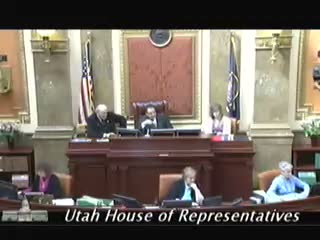
The Utah House on Jan. 30 debated HJR7, an Equine Resources joint resolution urging Congress to allow states discretion over the transport and processing of surplus domestic horses, and ultimately approved the resolution 51–14.
Representative (sponsor) introduced the resolution, saying federal actions have limited state options since U.S. processing plants closed in 2007 and that states need authority to address abandoned or surplus horses humanely. During floor debate, Representative Selig offered Amendment 1 (dated Jan. 30, 2009) to add language emphasizing ‘‘proper regulation, inspection, enforcement’’ rather than banning or exporting the problem. Selig explained the change was intended to underscore accountability: "...if people aren't held accountable to those regulations, then it doesn't matter," he said.
Representative Gibson and others cautioned against altering model or circulating language, with Representative Gibson saying she preferred uniform wording across states. After debate the House voted on Amendment 1 and the Speaker ruled the motion failed. The sponsor summarized the resolution by pointing to federal changes that eliminated processing options and urging state-level means to address the issue. The floor then voted to approve HJR7 with 51 yes votes and 14 no votes; the resolution will be transmitted to the Senate for further consideration.
The debate centered on whether the House should add explicit enforcement language or preserve broader, nationally circulating model text. Supporters emphasized humane handling and local control; opponents stressed the value of aligning with model language used by other states. No formal penalties or implementation measures were adopted in the resolution itself; it is a formal expression of the House's position to the federal government.
The next procedural step is transmittal to the Senate and any follow-up by interested stakeholders or committees.