Get Full Government Meeting Transcripts, Videos, & Alerts Forever!
Get email alerts on the Legislative Procedure topic
No spam. Unsubscribe anytime.
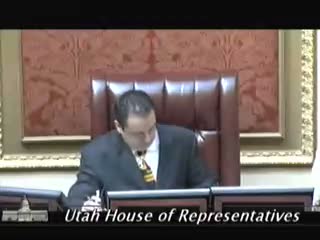
Utah House passes broad consent calendar and multiple bills on third reading
Summary
In a floor session Jan. 30, 2009, the Utah House approved a slate of consent-calendar measures and several third‑reading bills — including tax credit repeals, personal property tax amendments and traffic-incident statute clarifications — mostly by unanimous or lopsided votes.
The Utah House of Representatives approved a series of consent-calendar bills and multiple items from the third-reading calendar during its Jan. 30 floor session, sending them to the Senate or placing them on the calendar for further consideration.
Representative Julie Fisher described House Bill 20, a technical repeal of unused income tax credits and restricted accounts, as housekeeping; the measure passed 66–0 and was transmitted to the Senate. Representative Craig Frank said House Bill 28 amends personal property tax filing deadlines to accommodate an ‘‘abnormal’’ surge of roughly 80,000 returns to county assessors; HB28 passed 69–0. Representative Wayne Harper presented HB55 as a technical cleanup to restore a definition of alcohol sales subject to a 1% local-option tax and recorded the bill as passing 70–0.
On the third-reading calendar, Representative Hutchins explained HB24, Traffic Accident Clearance Amendments, saying it clarifies that drivers in non-injury crashes may move vehicles to a safe location to avoid secondary accidents and protect first responders; the bill passed 70–0. Representative Fisher later sponsored HB234 (Consumer Credit Protection Act modification), a cleanup to resolve duplicate chapter names in statute; HB234 passed 71–0. Several committee reports were adopted and multiple committee-recommended bills were placed on the third-reading calendar as reported.
The floor operated under consent-calendar rules: sponsors were limited to two-minute presentations and debate or amendments on consent items were not permitted. Committee chairs and the reading clerk reported favorable recommendations on a range of bills covering utilities, emergency management, municipal clerks and more.
Actions recorded on the floor included unanimous or near-unanimous tallies for the consent items and routine referrals to the Senate or placement on the third-reading calendar. The House concluded with announcements, recognition of visiting students, caucus calls and a motion to adjourn until the next scheduled session.
The House did not record any final Senate action within this transcript; transmission or referral to the Senate is the next procedural step for bills listed as ‘‘transmitted to the Senate for its consideration.’n