Get Full Government Meeting Transcripts, Videos, & Alerts Forever!
Get email alerts on the Energy Grid topic
No spam. Unsubscribe anytime.
Utah House approves bill letting utilities place telemetry on residential meters, shifts program to opt-out
Summary
The House passed third-substitute SB47 to expand a utility peak-demand program — moving residential telemetry and load control from opt-in to opt-out — after members debated protections for seniors and clarified the program applies to residential air-conditioner compressors only.
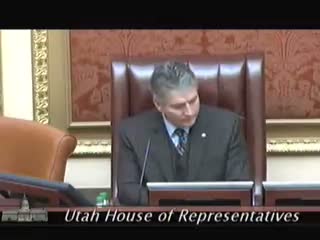
The Utah House of Representatives on March 11 approved third-substitute Senate Bill 47, authorizing utilities, under Public Service Commission oversight, to place telemetry equipment on residential electric service and to manage peak loads by temporarily cycling air-conditioner compressors. Representative Brown, the House floor sponsor, said the program is intended to reduce peak demand and delay costly capacity expansion.
"What it means is it allows the power company ... to place on your electric service what's called telemetry equipment," Representative Brown said, explaining the utility can temporarily shut an air-conditioner compressor during peak power events and offer participating customers lower rates. He described the measure as a cost-saving and peak-management tool used previously for agricultural pump users and now adapted for residential service under a tariff monitored by regulators.
Supporters framed the measure as a pragmatic way to manage peak load and to avoid building expensive generation. "If we don't start saving some of this energy, we're going to be looking at greater costs, more power plants and utility costs that keep going up and up and up," Representative Colville said in support. Sponsors repeatedly emphasized the program remains residential and would only interrupt the air-conditioning compressor while allowing the fan to continue circulating air, noting interruptions are short.
Opponents warned the change from an opt-in to an opt-out design could leave vulnerable residents, particularly some seniors, unaware their compressors might be cycled during hot afternoons. Representative Dunigan said, "I'm really concerned about this. This is going to be ... the heat of the summer will come on and they will have their air conditioning shut off and they will have no idea what's happening to them." The sponsor replied that the bill allows consumers to opt out and that the program had been described as minimally intrusive.
Lawmakers also clarified scope: Representative Brown said the bill is "strictly residential" and that the program affects compressors (not the fan) so air circulation continues. After debate and final passage, the House recorded 53 yes votes and 19 no votes and the measure was returned to the Senate for further consideration.
The House did not attach new statutory compliance or new criminal penalties to the bill; regulatory oversight was described as exercised by the Public Service Commission as part of utility tariff approval. The next step is further consideration or signature by the Senate following the House's concurrence vote.