Get Full Government Meeting Transcripts, Videos, & Alerts Forever!
Get email alerts on the Post Decertification topic
No spam. Unsubscribe anytime.
House debates formalizing POST decertification rules; substitute HB187 circled for further work
Summary
Lawmakers debated first-substitute HB187 to codify Peace Officer Standards and Training (POST) procedures, focusing on decertification standards, medical clearances and safeguards for officers. Members urged clarifications; the House circled the substitute for additional work.
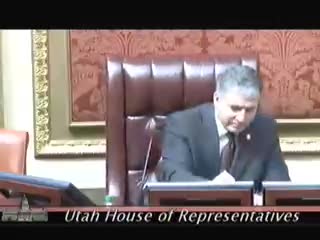
A first-substitute bill to codify Peace Officer Standards and Training (POST) procedures drew extended questioning Wednesday on the Utah House floor over how and when officers can be decertified.
Representative Carl Wimmer, the sponsor, said the substitute to House Bill 187 represents a consensus package developed with the Fraternal Order of Police and POST and ‘‘sets into code and codifies precisely what is expected of law enforcement officers and clearly codifies what actions POST can take and when they can take those actions.’’
The bill inserts procedural language now followed by POST into statute, Wimmer said, including the council’s authority to revoke certification in cases where an officer ‘‘willfully falsifies information’’ or is ‘‘addicted to alcohol or any controlled substance unless the peace officer reports the addiction to the employer and the director as part of a departmental early intervention process.’’ Wimmer said the change is intended to allow officers who come forward for help to avoid automatic decertification.
Several members pressed the sponsor on protections for officers. Rep. Doscupski asked whether POST could decertify an officer based on accusation rather than conviction; Wimmer replied that POST works under a preponderance-of-the-evidence standard and would need evidence that misconduct more likely than not occurred, not merely a ‘‘hunch’’ (preponderance described in floor remarks as roughly 55–60 percent on an evidentiary scale).
Other speakers recounted cases in which officers lost certification without criminal charges and said the statutory language should better guard career and retirement interests. Rep. Brown and others said the existing system had sometimes been ‘‘patently weighted against the law enforcement officer’’ and urged clarity; Rep. Wimmer argued the substitute is ‘‘a thousand times better than what the system we’re working on now’’ but welcomed further work.
Given the unresolved concerns, a motion was made to ‘‘circle’’ the first substitute to allow additional drafting and review. The House approved that motion and the bill was circled for further work rather than advanced tonight.
What happens next: Because the substitute was circled, legislative staff and sponsors are expected to revise statutory text and address members’ concerns before the bill returns to the floor.